Anansi News
HomeBriefsAsk GhanaTopicsTools
•
•

Stay Informed

Get AI-curated news briefs from Ghana delivered to your inbox every morning. Free forever, no spam.

Explore

  • Home
  • Briefs
  • About

Categories

  • Politics
  • Business
  • Sports
  • Entertainment
  • Africa

Features

  • Analysis
  • Cedi Rates
  • Dollar to Cedi
  • Ghana Gold Price
  • BoG Policy Rate

Topics

  • Armed Forces Recruitment
  • WAEC Results & News
  • Nana Ama McBrown
  • NDC News
  • All Topics

Legal

  • Privacy Policy
  • Terms of Service
Anansi News© 2026. All rights reserved.
Made withfor Ghana
africa

Somali Piracy Surges to 13-Year High Amid Escalating Regional Geopolitical Conflicts

Yesterday•2 min read•1 source
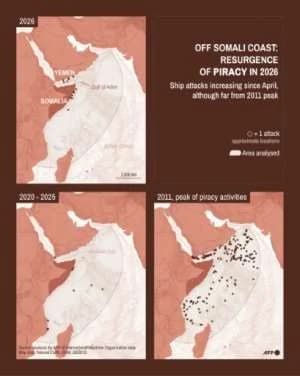
Infographic with maps of the coasts of East Africa showing pirate attacks against ships in 2026, from 2020 to 2025, and in 2011 in the Gulf of Aden, the western Indian Ocean, and the Arabian Sea, based on an AFP analysis of IMO data..  By Valentin RAKOVSKY, Sherine ELSAYARY (AFP)
  1. Home
  2. /Africa
  3. /Somali Piracy Surges to 13-Year High Amid Escalating Regional Geopolitical Conflicts

Piracy off the coast of Somalia has surged to its highest levels since 2013, marking a significant return of maritime threats to the Horn of Africa. According to an analysis of International Maritime Organization (IMO) data, at least 15 attacks have been reported in 2026 thus far. This represents a substantial increase from 2025, which saw only five recorded incidents, signaling a shift in the security landscape of the region’s vital shipping lanes.

The most high-profile incident of the year took place on April 21, when pirates seized the oil tanker Honour 25 along with its 17 crew members. While the current volume of attacks remains far below the historic peak of 2011—when approximately 200 incidents were recorded—the recent uptick indicates that pirate groups are becoming more active and successful in their operations. This resurgence has raised alarms for international maritime security forces who had largely seen the threat as neutralized over the past decade.

Analysts suggest that the surge is linked to broader geopolitical instability and conflicts involving major international actors, including the United States, Israel, and Iran. These tensions have significantly disrupted traditional shipping routes, particularly in the Gulf of Aden and the Red Sea. The resulting redirection of naval assets and general regional volatility have seemingly created a window of opportunity for Somali-based pirates to resume their activities with less immediate interference.

As piracy levels reach this 13-year high, the global shipping industry is facing renewed pressure to bolster onboard security and coordinate more closely with international naval coalitions. The implications of these attacks extend beyond immediate cargo loss, threatening to increase insurance premiums and disrupt global supply chains already strained by other regional conflicts. The situation remains fluid, with maritime authorities closely monitoring whether 2026 represents a localized spike or a sustained return to large-scale piracy off the Somali coast.

Our Take

From the Team

Coming Soon

Our team will add key insights, trends, and actionable takeaways to help you stay informed faster.

This story touches markets covered on Anansi Intelligence ↗.

More from africa

Continue exploring similar stories

Algeria Wildfires Kill 12 Amid Severe Heatwave While Ghana’s Ashanti Region Faces Plastic Waste Crisis
africa|Yesterday

Algeria Wildfires Kill 12 Amid Severe Heatwave While Ghana’s Ashanti Region Faces Plastic Waste Crisis

Environmental crises are currently impacting both North and West Africa, highlighting the continent's vulnerability to climate change and pollution. In northern Algeria, devastating wildfires have claimed the lives of at least 12 people and left 54 others injured as a severe heatwave grips the region. Simultaneously, in Ghana’s Ashanti Region, environmental health officials are warning of a burgeoning plastic waste crisis, which now accounts for a record 20% of all refuse generated in the area. In Algeria, the Interior Ministry reported that fatalities were concentrated in the provinces of Jijel, Bejaia, and Tizi Ouzou. Among the 54 injured, six remain in critical condition in intensive care units. Authorities recorded more than 150 fire outbreaks in a single day, with civil protection services struggling to contain the blazes amidst extreme temperatures and drought. The recurring nature of these wildfires, which have hit Algeria repeatedly this summer, is increasingly being linked to the broader impacts of global climate change on the Mediterranean climate. Further south in Ghana, the Ashanti Regional Environmental Health Officer, David Oppong Darko, has highlighted a significant shift in waste composition. Plastic waste has surged to become the second-most prevalent type of solid waste, surpassing textiles, metals, and glass. Darko noted that this shift poses a major environmental danger and has called for a public ban on styrofoam products to curb the proliferation of non-biodegradable waste. The data indicates that while organic matter remains the primary source of waste, the 20% plastic threshold represents a critical point for regional sanitation and environmental health. These developments underscore the multi-faceted nature of environmental threats across Africa, from immediate natural disasters to long-term pollution challenges. While Algeria focuses on emergency response and resident evacuation, Ghana is being urged to adopt stricter regulatory frameworks to manage non-biodegradable waste. Both scenarios demonstrate the urgent need for comprehensive environmental policies and infrastructure improvements to mitigate the risks posed by both climate-related catastrophes and urban waste management failures.

Vice President Opoku-Agyemang Champions Pan-African Agency as Ghana Prepares for Major Youth Forum on Reparations
africa|Yesterday

Vice President Opoku-Agyemang Champions Pan-African Agency as Ghana Prepares for Major Youth Forum on Reparations

Vice President Professor Jane Naana Opoku-Agyemang has issued a powerful call for Africans to take full ownership of their development and narratives, emphasizing that the essence of Pan-Africanism lies in the continent's ability to collaboratively shape its own future. Speaking at the Africa Mindset Reset Forum in Kigali, Rwanda, alongside leaders such as President Paul Kagame and former South African President Thabo Mbeki, the Vice President advocated for the establishment of local institutions and expertise. She stressed that education must be the cornerstone of empowering the youth to address regional challenges and called for an actionable commitment from African leaders to improve conditions for the underprivileged across the continent. This call for continental sovereignty aligns with upcoming grassroots initiatives in Accra, where the Pan-African Progressive Front (PPF) is set to host a major youth forum on September 5, 2026. Titled ‘Reclaiming Africa's Wealth, Resisting Neocolonial Bondage,’ the event will bring together students and youth groups from Ghana and the Alliance of Sahel States (AES)—comprising Mali, Burkina Faso, and Niger. Ambassadors from the AES member states are expected to address approximately 200 participants on critical issues including colonial debt, the future of the CFA franc, and the broader struggle for economic independence. The forum aims to move beyond rhetoric to foster active youth engagement in the quest for reparations and economic sovereignty, drawing inspiration from the Pan-African ideals of Dr. Kwame Nkrumah. Parallel to these political and economic discussions, there is a growing movement to reshape how Africa is perceived globally. During a media training session in Bolgatanga, Yakubu Akuka of ActionAid Ghana urged African journalists to adopt a more balanced and positive approach to storytelling. While acknowledging the necessity of reporting on challenges, Akuka emphasized that highlighting Africa's resilience and developmental successes is crucial for dismantling predominantly negative global stereotypes. This shift in narrative is viewed as a vital component of the broader Pan-African agenda, ensuring that the continent's stories are told with dignity and cultural sensitivity by those who live them. Domestically, Ghana continues to strengthen the internal stability necessary to lead such continental dialogues. The National Peace Council (NPC) recently reported significant progress in the Bawku peace talks, noting a positive commitment from both the Kusasi and Mamprusi communities to resolve their longstanding conflict. Supported by the UNDP and the Government of Japan, these discussions are fostering a constructive environment for reconciliation. Meanwhile, in Kumasi, the traditional social fabric remains robust as traders from the New Kejetia Market recently pledged their unwavering loyalty to the newly installed Asantehemaa, Nana Ama Bonsu. These strides in local peace and traditional governance provide a stable foundation for Ghana's continued advocacy for African unity and self-determination on the global stage.

African Union and ECOWAS Drive Regional Economic Reforms as Ghana Grapples with Stagnant Poverty Levels
africa|Yesterday

African Union and ECOWAS Drive Regional Economic Reforms as Ghana Grapples with Stagnant Poverty Levels

In a decisive push for continental economic autonomy, the African Union (AU) and the Economic Community of West African States (ECOWAS) are accelerating major financial initiatives aimed at lowering borrowing costs and unifying regional trade. The AU, through the African Peer Review Mechanism (APRM), is set to launch an African-owned credit rating agency this October to address perceived biases in international assessments that drive up interest rates for African nations. Simultaneously, ECOWAS has reaffirmed its commitment to launching the 'ECO' single currency by 2027, following high-level affirmations in Freetown, Sierra Leone. These moves represent a significant shift toward regional integration and monetary sovereignty across the continent. The ECO project, which has faced over two decades of delays, is now slated for a phased rollout starting with member states that meet the required convergence criteria. While the trademark for the currency has already been registered with the African Intellectual Property Organization, structural hurdles remain. Experts, including Alain Zagote of Fitch Advisory, have noted that significant economic disparities between member states and concerns over the loss of individual monetary sovereignty continue to pose challenges. Despite these obstacles, regional leaders maintain that the currency is essential for deepening the West African market and reducing dependence on external currencies. However, these high-level economic strategies are being implemented against a backdrop of persistent domestic hardship, as evidenced by recent data from Ghana. The World Bank’s 10th Ghana Economic Update and the Africa Policy Lens (APL) report indicate a sharp disconnect between macroeconomic stabilization and household welfare. Although Ghana experienced robust economic growth in 2025 and improved disinflation metrics under the current administration, the reports reveal that 56.4% of Ghanaians remained in poverty as of August 2026. The APL’s 'Ghana Wellbeing Tracker' highlights that while the national economy is technically 'stabilizing,' it is not yet 'thriving' for the average citizen. The findings underscore a critical challenge for both national and regional leadership: ensuring that macroeconomic recovery and institutional reforms translate into tangible improvements in living standards. The World Bank and APL emphasize that without focused job creation and a deliberate effort to link growth to household welfare, high-level initiatives like the ECO or a continental credit rating agency may fail to alleviate the immediate pressures on the populace. As the AU prepares its rating agency launch and ECOWAS moves toward its 2027 target, the focus remains on whether these systemic changes can bridge the gap between economic indicators and the lived reality of millions of citizens across the region.

A participant trying to put out a fire from the simulation exercise as part of the training
africa|Yesterday

Ghanaian Communities Benefit from Widespread Economic Support and Environmental Restoration Projects

Across Ghana, a wave of community-focused initiatives is driving economic independence and environmental sustainability through targeted resource distribution and capacity building. From the coastal fishing hubs of the Western Region to the shea landscapes of the Upper West, local assemblies and non-governmental organizations are deploying resources to empower vulnerable groups and protect the nation's natural heritage. These efforts, ranging from livelihood equipment distributions for persons with disabilities to forest monitoring tools and specialized vocational training, signal a coordinated push toward inclusive development and climate resilience. In the Eastern Region, the Lower Manya Krobo Municipal Assembly has provided vital livelihood support to over 30 Persons with Disabilities (PwDs) to enhance their economic independence. Funded by the Disability Fund of the District Assembly Common Fund (DACF), the assembly distributed essential items including freezers, wheelchairs, cooking oil, and cassava grinding machines. Municipal Chief Executive John Atteh Matey emphasized that the initiative is designed to create economic opportunities and reduce poverty among vulnerable populations. He urged beneficiaries to use the items responsibly to establish sustainable livelihoods, noting that "disability does not mean inability." This distribution marks the second batch of support under current leadership, with a third phase already in planning. Environmental protection also received a significant boost as Proforest donated 22 motorbikes to the Ahafo Regional Forestry Commission to enhance patrol capabilities. This initiative is part of a broader project to rehabilitate 450 hectares of degraded forest under the Ghana Cocoa Forest REDD+ Programme, supported by international partners like Mondelēz International and Sainsbury's. Proforest’s Global and Africa Director, Abraham Baffoe, noted that the motorbikes would allow field officers to access remote areas and respond swiftly to illegal activities. Simultaneously, in the Upper West Region, the Centre for Indigenous Knowledge and Organizational Development (CIKOD) launched the Shea Enrichment Planting Initiative. This project aims to restore degraded shea landscapes while positioning the sector as a driver for economic transformation, particularly for women who anchor the shea economy. In the Western Region, Karpowership Ghana has conducted a specialized training program for fishermen and fishmongers in Sekondi and Essikado. Organized in collaboration with the Ghana National Fire Service and the Fisheries Commission, the program focused on fire safety, environmental hygiene, and financial management. The training was specifically tailored to address recent fire incidents at fishing harbors and provided participants with practical knowledge on maintaining hygienic fish handling standards and financial literacy. These diverse regional efforts collectively illustrate a robust commitment to enhancing the quality of life for Ghanaians by combining direct material support with long-term environmental and vocational stewardship.

All
africa
business
education
entertainment
health
news
politics
sports
technology