••
Karl Deisseroth, Peter Hegemann, and Georg Nagel Awarded 2026 Nobel Prize in Medicine for Optogenetics Breakthrough
•2 min read•1 source
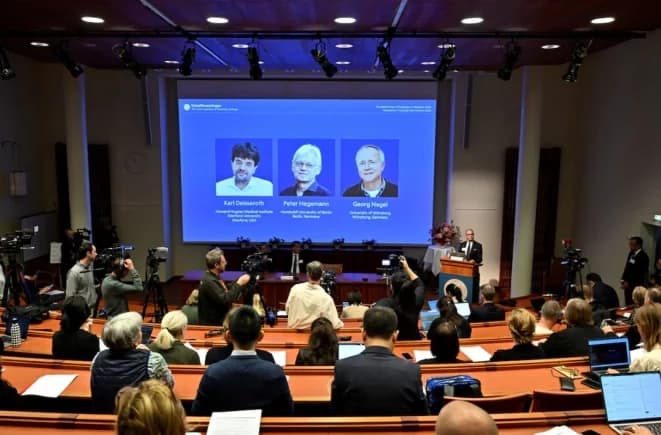
The 2026 Nobel Prize season has officially commenced with the prestigious Physiology or Medicine award being bestowed upon a trio of pioneering scientists: Karl Deisseroth of the United States, and Peter Hegemann and Georg Nagel of Germany. The Nobel Assembly announced on Monday that the researchers were selected for their groundbreaking discoveries in optogenetics, a revolutionary technique that uses light to control the activity of living neurons. This announcement marks the beginning of the annual Nobel week, which runs from October 5 to October 12, honoring contributions that have conferred the greatest benefit on humankind.
Optogenetics has transformed the landscape of neuroscience by allowing researchers to manipulate nerve cell activity with unprecedented precision. By integrating light-sensitive proteins into cells, the winners developed a method to "switch" specific neurons on or off using laser light. This tool has become indispensable for understanding the intricate circuitry of the brain, offering insights into how neurological processes govern behavior and health. Beyond basic research, the application of optogenetics holds significant clinical promise, particularly in the field of ophthalmology where it is being explored as a potential means to restore vision in patients suffering from blindness.
Upon receiving the news, the three laureates expressed both surprise and immense delight at being honored collectively for their collaborative and individual efforts. The Nobel Prize includes a monetary award of 12 million Swedish crowns, equivalent to approximately $1.2 million, which the trio will share. Their recognition underscores the importance of interdisciplinary work, combining principles of physics, biology, and chemistry to solve some of the most complex puzzles of human physiology.
As the first of the 2026 Nobel Prizes to be revealed, this award sets a high bar for the announcements to follow in Physics, Chemistry, Literature, Peace, and Economic Sciences. The impact of optogenetics is expected to grow as researchers refine the technology for therapeutic use, potentially leading to new treatments for Parkinson’s disease, depression, and other neurological disorders. The global scientific community now looks forward to the remaining announcements, celebrating the innovations that continue to push the boundaries of human knowledge and medical capability.
