••
President Mahama Demands Permanent African Seats on UN Security Council and Climate Justice at 81st UNGA
•3 min read•30 sources
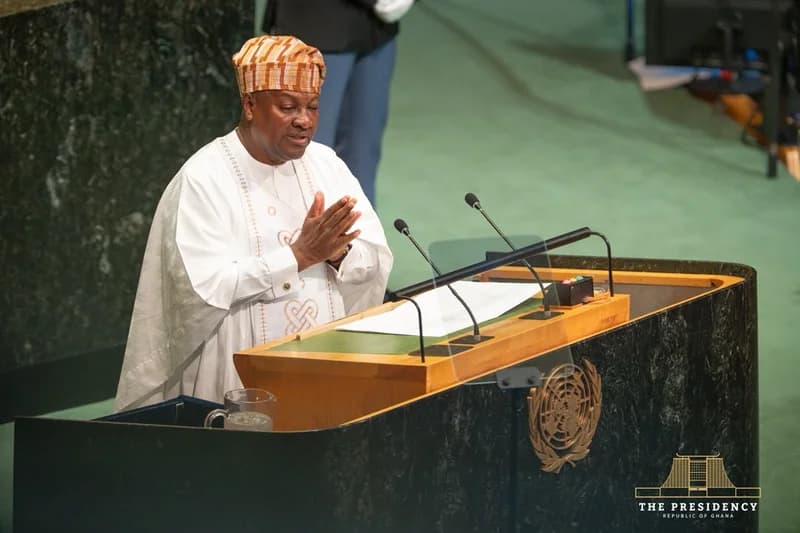
Addressing the 81st Session of the United Nations General Assembly, President John Dramani Mahama issued a powerful call for the structural transformation of global governance, asserting that Africa seeks equitable partnerships rather than charity. Highlighting the continent’s demographic and political significance, President Mahama argued that Africa’s continued exclusion from permanent membership on the UN Security Council is a vestige of historical inequality that undermines the institution's legitimacy. He formally demanded at least two permanent and five non-permanent seats for Africa, including veto rights if they remain part of the Council’s framework. The President emphasized that with 1.5 billion people and the largest regional voting bloc, Africa must be a central architect in global security decisions rather than a mere subject of them.
President Mahama’s address also focused heavily on the supremacy of international law, criticizing a growing trend toward unilateralism and the doctrine of "might makes right." He specifically condemned the humanitarian crisis in Gaza, calling for an immediate end to collective punishment and reaffirming Ghana’s unwavering support for a sovereign Palestinian state and a two-state solution. While denouncing the terrorist acts of Hamas, the President urged the international community to apply humanitarian standards consistently across all conflicts, including the war in Sudan. In a notable departure from the rhetoric of some global powers, Mahama criticized threats of "annihilation" against sovereign nations like Iran and reiterated Ghana’s long-standing demand for the lifting of the economic embargo on Cuba, which he described as a disproportionate burden on ordinary citizens.
Turning to the environment, the President described climate change as the "ultimate test of global equity." He pointed out the irony that Africa contributes less than 4% of global greenhouse gas emissions yet remains the most vulnerable to its devastating impacts, citing recent catastrophic floods in Ghana that claimed 39 lives. Mahama challenged developed nations to fulfill their financial commitments through non-debt-creating grants rather than loans that deepen the financial burdens of developing states. He further linked this call for justice to global health, advocating for the establishment of regional vaccine manufacturing hubs in the Global South to ensure Africa is not left behind in future health emergencies.
Ghana’s leadership on the global stage was further acknowledged through praise from Brazilian President Luiz Inácio Lula da Silva, who lauded a Ghana-led UN resolution declaring the transatlantic trafficking of enslaved Africans a crime against humanity. This initiative, championed by President Mahama, calls for reparatory justice and historical correction, alongside the "Correct the Map" resolution aimed at modernizing outdated world representations. As the 81st Session concludes, Mahama’s message remains clear: Africa is ready to process its own resources, grow its economy through the African Continental Free Trade Area (AfCFTA), and participate in a global order defined by mutual respect and the uniform application of the UN Charter.
Related topic
John Mahama: Latest News & Updates →

