••
President Mahama Advocates Health Sovereignty While Local Innovators Target Ghana's Healthcare Gaps
•3 min read•2 sources
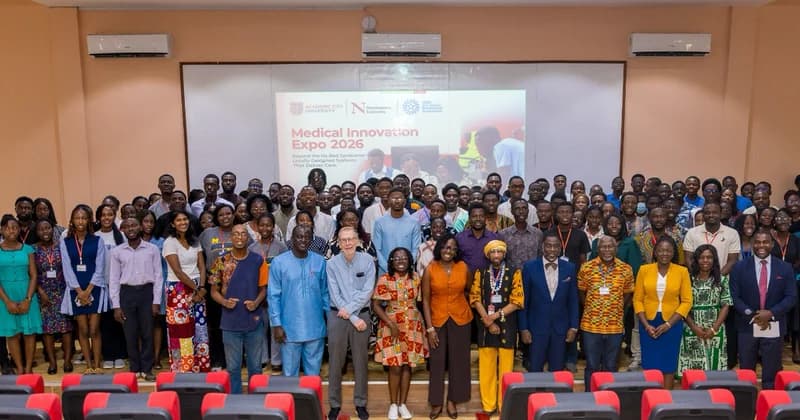
President John Mahama has called for a fundamental shift in how African nations approach healthcare, urging leaders to prioritize "health sovereignty" as a cornerstone for economic growth. Speaking at the Alamein Africa Forum in Egypt, the President argued that health must no longer be viewed as a charitable cost or a mere budget line-item but as a vital, self-sustaining economic sector. This high-level advocacy aligns with domestic efforts in Ghana, where the recently concluded Ghana Medical Innovation Expo 2026 underscored the urgent need for locally manufactured, low-cost medical solutions to address systemic challenges.
During his address in Egypt, President Mahama highlighted the continent's precarious reliance on imported pharmaceuticals, which poses a significant risk to healthcare security. To counter this, he introduced the Health Investment and National Gateway (HINGE) initiative, designed to streamline regulations and attract private capital into the health sector. By fostering an environment conducive to local manufacturing, the President aims to transform Africa from a consumer of external medical goods into a hub of health innovation and production, emphasizing that healthcare investment is an essential driver of broader economic stability.
Back in Ghana, the push for self-reliance was echoed at the Ghana Medical Innovation Expo 2026, themed "Beyond the No-Bed Syndrome." Dr. Lawrence Ofori Boadu of the Ghana Health Service (GHS) emphasized the necessity of collaborating with local innovators to design medical equipment specifically tailored to the Ghanaian environment. A key focus of the expo was the implementation of an integrated bed management system, a technological intervention aimed at streamlining patient referrals and mitigating the perennial shortage of hospital beds in major facilities.
The expo, held in partnership with Academic City University and Northeastern University, brought together policymakers, engineers, and healthcare professionals to seek sustainable solutions. Dr. Ibrahim Badejo of Johnson & Johnson MedTech reminded participants that for innovation to be effective, it must directly target unmet local needs and remain maintainable within the domestic infrastructure. This collaborative approach between government, academia, and the private sector mirrors President Mahama’s call for sustainable health solutions that move beyond traditional aid-dependent models.
Ultimately, these combined efforts signal a strategic move toward a more resilient Ghanaian health system. By integrating the HINGE initiative’s regulatory reforms with the grassroots innovations showcased at the Expo, Ghana is positioning itself to bridge the gap in healthcare delivery. The transition toward local production and specialized technological solutions not only promises to improve patient outcomes but also serves as a critical driver for national industrialization and economic sovereignty.
Related topic
John Mahama: Latest News & Updates →

