••
President Mahama Anchors Ghana’s Economic Strategy on Mineral Value Addition and Local Content Reforms
•3 min read•10 sources
President John Dramani Mahama has lauded the Ghana Gold Board for achieving a significant financial turnaround, recording a net profit of GH₵896.5 million for the 2026 financial period. Speaking at the Governing Boards and CEOs Conference, the President highlighted this performance—a substantial increase from the GH₵178.5 million recorded in 2024—as a testament to the nation's efforts to stabilize the economy through more active management of gold trade and foreign exchange. The Gold Board is currently projected to generate approximately $1.40 billion in foreign exchange by late 2026, aimed at bolstering the Bank of Ghana’s reserves and supporting critical infrastructure projects.
This domestic success aligns with Ghana’s aggressive international push for mineral value addition. At the China Mining Conference in Tianjin, Ghana’s Ambassador to China, Kojo Bonsu, reaffirmed the government’s commitment to local beneficiation, particularly the refinement of bauxite into alumina. Ambassador Bonsu emphasized that Ghana is shifting away from the export of raw materials to domestic processing to create jobs and enhance technical capacity. Supporting this transition, Minister for Lands and Natural Resources Emmanuel Armah-Kofi Buah noted that while the sector faces challenges like illegal mining and gaps in geological data, regulatory reforms are being prioritized to transform mining into a cornerstone of national development.
To safeguard the workforce during this transition, the Minerals Commission of Ghana is currently drafting minimum wage and tender benchmarks for mining contractors. This initiative follows a January 2025 directive mandating that surface mining operations be outsourced exclusively to Ghanaian-owned firms, with a December 31, 2026, deadline for underground mines to establish joint ventures with at least 50% local ownership. Ben Birch-Mensah, Director of Local Content at the Commission, stated that these benchmarks are essential to prevent aggressive underbidding, which often results in wage cuts and compromised safety standards. While the Ghana Chamber of Mines supports the move to curb unhealthy competition, it has raised concerns regarding the mandatory nature of contract mining.
In the energy sector, the government is simultaneously expanding its offshore capabilities. Energy Minister Dr. John Jinapor recently signed two Memoranda of Understanding with Eni Ghana and Vitol Upstream Tano Limited to finalize petroleum agreements for offshore blocks GH WB 3 and GH WB 8. These blocks, covering 2,100 square kilometers in the Tano Basin, align with an infrastructure-led exploration strategy intended to maximize existing offshore facilities. Furthermore, Ghana is positioning itself to capitalize on the global green energy transition by developing its lithium and bauxite reserves, with the Ewoyaa Lithium Project expected to produce 365,000 tonnes annually to meet surging global demand for renewable energy components.
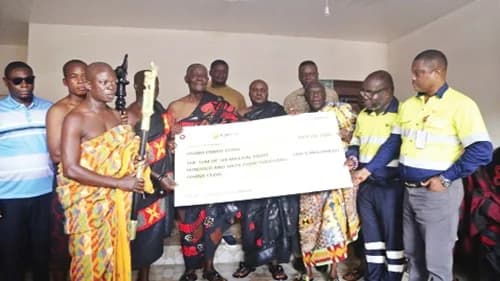
As these industrial policies take shape, corporate social responsibility remains a key focus for maintaining community trust. Perseus Mining (Ghana) Limited recently demonstrated this by donating GH₵6.86 million to the Ayanfuri community for local development projects. Moving forward, Ghana's economic resilience will depend on the successful implementation of these value-addition policies and the Gold Board's ability to maintain transparent governance. By integrating local content requirements with strategic international partnerships, the Mahama administration aims to ensure that the nation’s vast natural resource wealth translates into sustainable industrial growth and long-term financial stability.
Related topic
John Mahama: Latest News & Updates →Live rates
Ghana gold price →

