••
President Mahama Demands "Measurable Value" as Ghana’s SOEs Turn GH¢19.8bn Profit Amid IMF Governance Warnings
•3 min read•19 sources
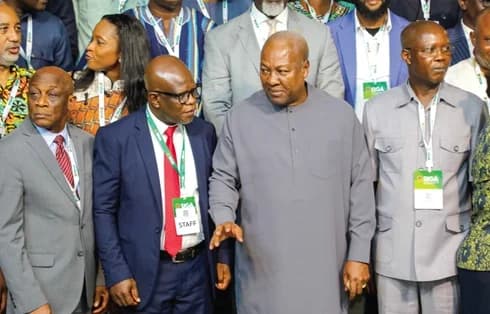
President John Dramani Mahama has issued a stern directive to the leadership of State-Owned Enterprises (SOEs), demanding they deliver "measurable public value" or face immediate leadership changes. Speaking at the 2026 SIGA Governing Boards and CEOs Conference in Accra, the President emphasized that public assets are held in trust for the Ghanaian people and must yield tangible benefits. This call for accountability comes as the 2025 State Ownership Report revealed a significant financial turnaround, with SOEs reporting a consolidated net profit of GH¢19.8 billion, a stark recovery from the GH¢2.26 billion loss recorded in 2024. Despite this improvement, the President warned that the national budget cannot continue to prop up inefficient entities, stressing that high performance will be rewarded while persistent underperformance will attract consequences.
To institutionalize this accountability, President Mahama announced the proposed Independent Public Emoluments Commission (IPEC), which will replace the Fair Wages and Salaries Commission. The IPEC is designed to directly link the remuneration of SOE executives to their institutional performance and service quality. Furthermore, the President cautioned Board Chairpersons against meddling in the day-to-day management of their respective entities. He clarified that while boards are responsible for strategic direction, risk oversight, and financial integrity, they must not assume full-time executive roles. This clear distinction between governance and management is intended to foster professional autonomy and ensure that chief executives are held strictly responsible for annual growth and value creation metrics.
While the financial reports show a profit surge, the sector continues to face intense scrutiny from international partners and domestic investigators. A July 2026 Technical Assistance Report from the International Monetary Fund (IMF) highlighted deep-seated governance challenges, specifically criticizing the "politicization" of board appointments and centralized control by the Presidency. The IMF flagged entities like the Ghana Ports and Harbours Authority (GPHA) and the Volta River Authority (VRA) as being dominated by political figures, which may undermine independent oversight. Additionally, the IMF criticized the Ghana Cocoa Board (COCOBOD) for procurement weaknesses, noting that 87% of its cocoa roads contracts were awarded without competitive tendering. These findings sparked a sharp rebuttal from Majority Chief Whip Rockson-Nelson Dafeamekpor, who accused the IMF of political bias and interfering in Ghana’s constitutional frameworks.
The financial health of the sector remains a point of concern despite the recent profit, as total SOE liabilities reached approximately GH¢282 billion by the end of 2025, set against total assets of GH¢407.85 billion. This fiscal vulnerability is compounded by ongoing integrity checks, including a recent Economic and Organised Crime Office (EOCO) investigation into former BOST Deputy MD Joseph Kpemka regarding alleged financial irregularities in a fuel supply contract. Moving forward, the government has directed the State Interests and Governance Authority (SIGA) to publish annual performance assessments for all entities. This transparency drive, coupled with Sammy Gyamfi’s leadership at the Ghana Gold Board in promoting alternative financing and public-private partnerships, signals a broader shift toward fiscal discipline and reduced reliance on state funding.
Related topic
John Mahama: Latest News & Updates →Live rates
Ghana gold price →

