••
President Mahama Drives Industrialization with New Automotive Thresholds Amidst Intensified Accountability Probes
•3 min read•13 sources
President John Dramani Mahama has announced a significant shift in Ghana’s industrial policy, introducing a minimum local assembly threshold for vehicle manufacturers to qualify for Value Added Tax (VAT) exemptions. Speaking at the commissioning of Phase Three of the Zonda Tech Ghana Limited assembly plant in September 2026, the President emphasized that the new measure aims to prevent manufacturers from claiming incentives on nearly fully assembled imported vehicles. While specific percentage requirements will be detailed in the upcoming national budget, the policy is designed to foster a genuine local manufacturing ecosystem, positioning Ghana as a competitive automotive hub in West Africa. President Mahama further challenged the banking sector to develop long-term, salary-based vehicle financing to ensure locally assembled cars remain affordable for the average Ghanaian worker.
Beyond vehicle assembly, the President is pushing for a deeper integration of the automotive supply chain, urging companies like Zonda Tech to begin local production of essential components such as batteries and tires. This initiative aligns with a broader national strategy to lead in electric mobility, leveraging Ghana’s strategic minerals for battery production and establishing infrastructure like solar charging stations. Parallel to these industrial efforts, the President has inaugurated the Presidential Committee on Accelerated Export Development (PCAED). Chaired by Mahama himself, the committee is tasked with boosting non-traditional exports from $3.5 billion to $10 billion by 2030, focusing on systemic reforms to capitalize on the African Continental Free Trade Area (AfCFTA).
On the front of governance and justice, the Mahama administration has launched several high-profile investigations into past financial deals and incidents of political violence. The President has ordered probes into the PDS agreement, the National Cathedral project, and the utilization of COVID-19 funds under the previous administration. Furthermore, investigations have been reopened into the 2020 Techiman South election shooting and the 2019 Ayawaso West Wuogon disturbances. President Mahama stated that these moves are essential for restoring public trust and ensuring accountability, noting that charges have already been filed against certain former officials for financial irregularities.
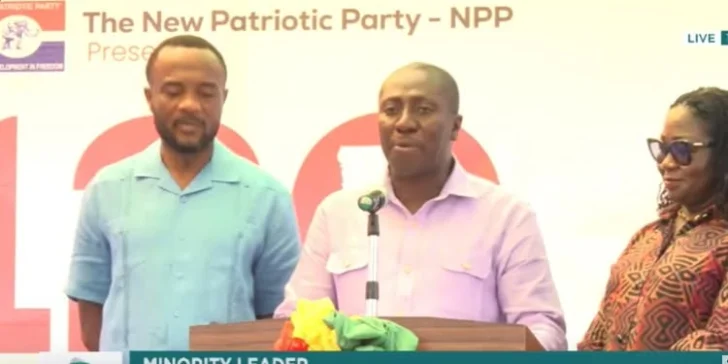
However, the administration faces sharp criticism from the New Patriotic Party (NPP) and the Minority in Parliament. Minority Leader Alexander Afenyo-Markin described the President’s performance as "uninspiring," labeling his first 120 days a "cocktail of failed promises." The opposition has accused the government of "executive lawlessness" and misleading the public on projects like the chip-embedded e-Passport rollout, which they claim is a rebranding of former President Nana Akufo-Addo’s legacy. Despite these political tensions, governance experts have noted some progress in economic stabilization, though they caution that significant challenges remain regarding anti-corruption measures and the management of State-Owned Enterprises (SOEs), which recently saw a shift from heavy losses to a reported profit of GH₵19.8 billion in 2025.
Related topic
NPP (New Patriotic Party): Latest News →

