••
President Mahama and African Leaders Call for Global Financial Reform to Tackle Debt Crisis and Stimulate Growth
•3 min read•4 sources
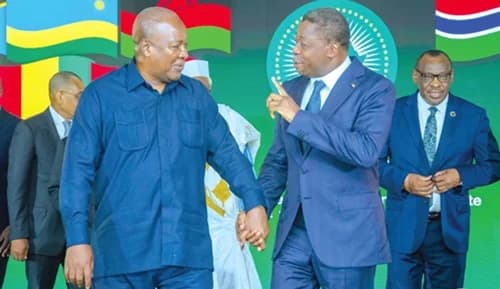
President John Mahama has called for a "Common African Position" and unified continental action to confront an escalating debt crisis that threatens to derail development across Africa. Speaking at the African Union (AU) High-Level Conference on Debt in Lom, Togo, President Mahama highlighted a staggering paradox where many African nations are currently spending more on debt servicing than on health and education combined. With data from the International Monetary Fund and the African Development Bank indicating that 22 African nations are at high risk of debt distress, the President emphasized that the current trajectory of unsustainable borrowing risks undermining decades of progress. He proposed a three-pillar strategy focusing on transparency, productive borrowing, and global financial reforms to reduce reliance on foreign loans.
Supporting the call for systemic change, Arancha Gonzlez Laya, former Spanish Foreign Affairs Minister and Co-Chair of the Future of Development Cooperation Coalition, underscored the need for significant reforms to global financial regulations during a recent visit to Ghana. She pointed out that the prohibitively high cost of capital for low- and middle-income countries hinders vital investments in essential sectors like electricity and IT. Both leaders have criticized the slow progress of international mechanisms such as the G20 Common Framework, urging African nations to rally for better terms and more equitable risk assessment models on the global stage.
On the domestic front, the push for economic transformation is being tied to the empowerment of micro, small, and medium enterprises (MSMEs) and the full implementation of the African Continental Free Trade Area (AfCFTA). Betty Mould-Iddrisu, a member of Ghana’s Council of State, recently stressed that Africa’s development challenges cannot be solved in isolation, calling for deep collaboration between governments, the private sector, and academia. Ghana’s Minister of Trade, Elizabeth Ofosu-Adjare, echoed these concerns, noting that while MSMEs are the backbone of the economy, they are restricted by financing gaps. To counter this, government initiatives like the establishment of a Women’s Development Bank are being prioritized to foster inclusive enterprise growth.
As Africa seeks to modernize its financial architecture, the role of digital assets and robust regulatory frameworks has also moved to the forefront of the policy agenda. The Digital Assets Summit Africa (DASA), a collaboration between ProMark Elite Limited and KPMG, is working with the Bank of Ghana and other regulators to establish the institutional capacity needed to manage virtual assets. By focusing on consumer protection, taxation, and cybersecurity, these stakeholders aim to ensure that blockchain and digital finance contribute to the stability of the continent's financial systems. Together, these efforts represent a multi-faceted approach to achieving the African Union’s Agenda 2063, balancing the need for global structural reform with local innovation and fiscal discipline.
Related topic
John Mahama: Latest News & Updates →

