••
University of Cape Coast Honors Kwesi Pratt Jnr and Secures $500 Million Student Housing Agreement
•2 min read•4 sources
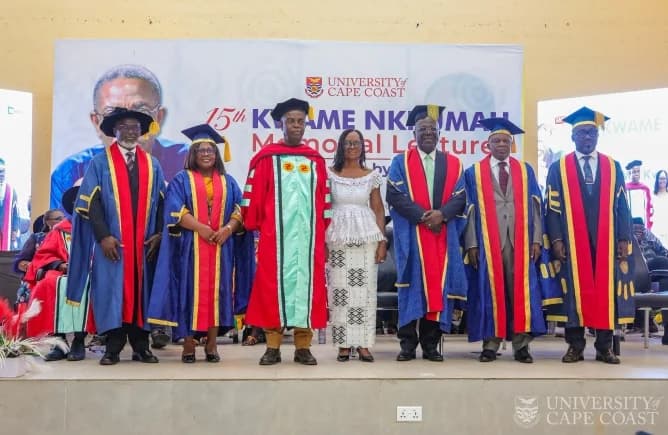
The University of Cape Coast (UCC) has marked a significant milestone in its institutional development, combining high-level academic recognition with a major infrastructure announcement. During a special congregation held in September 2026, the university conferred an honorary Doctor of Letters (D.Litt.) on veteran journalist and Pan-Africanist Kwesi Pratt Jnr. The ceremony served as a platform for UCC leadership to outline a bold vision for the university's future, including a massive $500 million partnership to address chronic student accommodation shortages and the expansion of digital learning through a new e-Campus initiative.
Chancellor Sir Sam Jonah used the occasion and the preceding 15th Kwame Nkrumah Memorial Lectures to challenge the national discourse on development. He critiqued what he described as sixty years of redundant arguments over the legacy of Ghana's first president, Kwame Nkrumah, urging the nation to pivot toward practical nation-building. Sir Sam Jonah emphasized that Nkrumah’s contributions should be measured by tangible physical and institutional progress rather than political debate. In his acceptance speech, Kwesi Pratt Jnr echoed these sentiments, reflecting on his lifelong commitment to African liberation and the enduring influence of Nkrumah’s ideals on his career in independent journalism.
Complementing these academic celebrations, UCC formalized a Memorandum of Understanding (MoU) with GSC Property Investment Limited for a landmark $500 million student accommodation project. This initiative, which is structured under a Build-Operate-Transfer (BOT) model, will see the construction of 28 dormitory blocks capable of housing 28,000 students. The project also includes various commercial facilities to serve the campus community. GSC Property Investment Limited will finance and manage the facilities for a 30-year period before transferring ownership back to the university, with the first phase of construction scheduled to begin in January 2027.
Vice-Chancellor Prof. Denis Aheto highlighted that these developments are part of a broader strategy to modernize the institution and enhance the student experience. Beyond the physical expansion of the campus, the university is also promoting its e-Campus platform, which offers a variety of accredited advanced programs to a global audience. These combined efforts in infrastructure, technology, and public engagement underscore UCC's commitment to remaining a central pillar of higher education and democratic discourse in Ghana.


