••
Dutch Students Debut 'Stella Juva' Solar-Powered Ambulance in Successful Kenya Field Trial
•2 min read•1 source
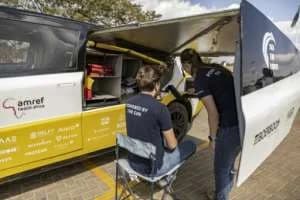
A pioneering team of Dutch students has successfully concluded the initial test run of 'Stella Juva,' recognized as the world’s first solar-powered ambulance, during a trial period in Kenya. This landmark project aims to revolutionize medical access in remote and off-road regions where traditional emergency services often fail to reach due to poor infrastructure or lack of fuel. By utilizing renewable energy, 'Stella Juva' offers a dual solution: providing reliable medical transport while minimizing the carbon footprint of emergency healthcare delivery. The vehicle represents a significant leap forward in addressing the 'last mile' of healthcare delivery in developing nations. Engineered for endurance and versatility, the 'Stella Juva' is a two-seat vehicle designed to withstand the rigors of rural African terrain. On a single day of sunshine, the ambulance can achieve a range of roughly 715 kilometers, a feat made possible by high-efficiency solar panels integrated into its design. These panels do more than just propel the vehicle; they provide the necessary electricity to power sophisticated medical devices on board. The ambulance is currently equipped with ultrasound scanners and specialized testing kits for tuberculosis, allowing it to function as a mobile diagnostic hub in areas without stable power grids. The potential impact of this technology on public health is significant, particularly in rural Kenya. Geoffrey Sadera, representing Amref Health Africa, hailed the vehicle as a 'game changer,' with a specific emphasis on its benefits for maternal and child health. By bringing diagnostic tools directly to pregnant women in remote villages and providing a reliable means of transport during emergencies, the solar ambulance addresses two of the most critical barriers to reducing maternal mortality. The trial has demonstrated that high-tech, sustainable solutions can be effectively adapted for even the most challenging geographical environments. Beyond its immediate medical utility, the 'Stella Juva' project serves as a call to action for further innovation in sustainable healthcare technology. The success of the Kenyan trial suggests that solar power could be the key to overcoming logistics and energy hurdles in rural development. As the student team looks toward the future, their work highlights how academic research and international cooperation can yield practical, life-saving tools. This successful test run marks a vital step toward a future where healthcare access is no longer dictated by geography or the availability of fossil fuels.