••
St John’s School Leads Wave of Community-Driven Educational Support with GH¢6.5 Million Expansion Project
•3 min read•11 sources
Education in Ghana is receiving a significant boost through various community-led initiatives, ranging from major infrastructure fundraising to innovative environmental projects. St John’s School in Sekondi has launched a GH¢6.5 million fundraising campaign to mark its 75th anniversary, aimed at constructing a modern three-storey classroom block. Simultaneously, the Global Evangelical Church (GEC) Accra Presbytery Women’s Ministry has donated learning materials and supplies valued at GH¢12,000 to the GEC Basic School in Kotobabi. These efforts, alongside contributions from regional associations and NGOs, highlight a growing commitment among non-state stakeholders to enhance the quality of teaching and learning environments across the country.
The St John’s School project, themed "United in Purpose, Committed to Excellence," focuses on building 15 new classrooms and three laboratories to accommodate its growing student population. During the anniversary launch, school leadership and alumni emphasized the institution's 75-year legacy of academic and moral development, calling on the "Old Saints" alumni network and corporate partners to help modernize the school's infrastructure. In a similar vein of institutional support, the GEC Women’s Ministry’s donation of exercise books, writing utensils, and cleaning supplies serves as a precursor to their upcoming 2026 Rally. Reverend Mrs. Mercy Motte-Kpegla noted that supporting the welfare of students is a communal responsibility and a vital part of the church’s mission to nurture the next generation.
In the Western Region, the YMCA is blending environmental sustainability with educational support through its "Green Futures Project." The initiative recently donated its first 50 "Green Bags" to pupils at Funko M/A School, featuring bags manufactured from upcycled plastic waste. With over 50,000 pieces of plastic already recovered through community clean-ups, the project aims to distribute 2,000 of these eco-friendly bags to ten schools within the next year. Project lead Goddy Nana Mens highlighted that the bags, which include personalized encouragement cards and essential learning materials, demonstrate how environmental waste can be transformed into valuable educational resources.
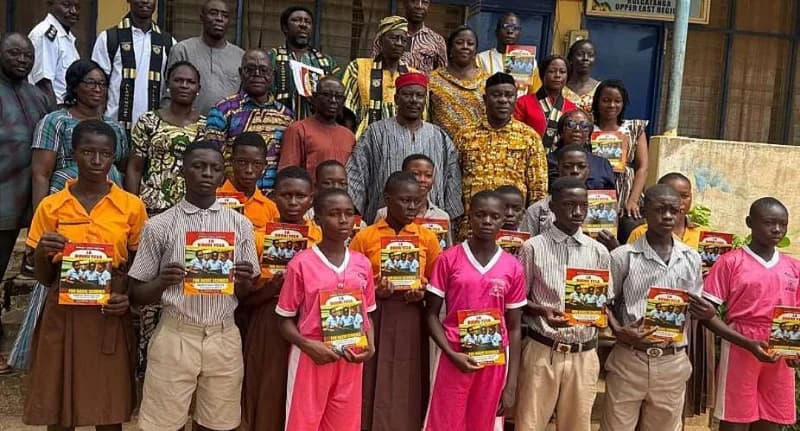
Furthermore, cultural preservation and local language literacy are being addressed in the Upper East Region. The Alagumgube Association recently donated 260 Gurenə language books to the Regional Education Directorate to support teaching in basic schools across five municipal and district directorates. By providing these mother-tongue textbooks, the association seeks to protect indigenous heritage while improving literacy outcomes. Collectively, these diverse interventions—spanning from physical infrastructure and eco-friendly supplies to linguistic resources—underscore a nationwide drive to address the multifaceted needs of Ghanaian students through local initiative and partnership.


