••
Myanmar Military Airstrike Kills 49 in Rakhine State Amid Global Humanitarian and Justice Developments
•3 min read•10 sources
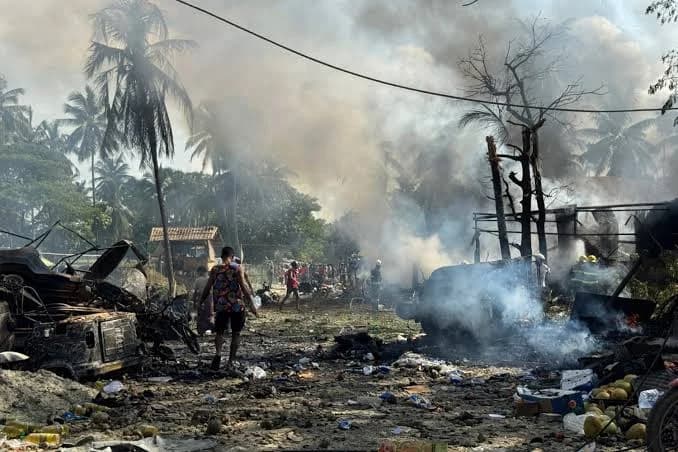
A devastating airstrike by the Myanmar military in the country’s Rakhine State has left at least 49 people dead and 58 others injured, marking one of the most lethal escalations in the region since the 2021 coup. The attack, which occurred in early October 2023, targeted a busy market and wholesale center in Kyauktaw township, an area currently under the control of the Arakan Army (AA). Witnesses and rescue officials described a scene of massive destruction, with a fighter jet reportedly dropping bombs directly onto vendors and shoppers during the midday rush. The military, which has been embroiled in a widespread conflict with pro-democracy and ethnic armed groups for years, has defended its actions by claiming it only targets legitimate military threats, though the high civilian toll in this instance has drawn sharp international condemnation.
The Arakan Army, which seeks autonomy for the ethnic minority in Rakhine, has vowed to retaliate against those responsible for the strike. This incident is part of a broader, intensifying humanitarian crisis in Myanmar, where restricted trade routes and persistent violence have led to severe food shortages. The conflict has significantly escalated since the military seized power from the government of Aung San Suu Kyi on February 1, 2021. As the AA continues its offensive against the ruling junta, the civilian population remains caught in the crossfire of a war that shows no signs of abating, further complicating the delivery of aid to the region.
While the violence in Myanmar highlights the immediate dangers of state-led aggression, other global developments underscore the protracted nature of justice and accountability in human rights cases. In Rome, a court recently sentenced three Egyptian security officials to 10 years in prison for the aggravated kidnapping of Italian researcher Giulio Regeni in Cairo—a case that has been a point of international friction since 2016. Similarly, in the United States, the release of Douglas Stewart Carter after 41 years on death row in Utah following new DNA evidence highlights the systemic challenges within judicial frameworks. These cases reflect a global trend where the pursuit of truth and legal redress often takes decades to manifest, leaving victims and their families in prolonged states of uncertainty.
The ability of international organizations to respond to these compounding crises is further threatened by a severe funding shortfall. The United Nations High Commissioner for Refugees (UNHCR) has warned that nearly 8.3 million forcibly displaced individuals are at risk of losing essential assistance as its budget has shrunk from $5.2 billion in 2024 to an expected $3.9 billion in 2025. With only a fraction of required funds received from major donors, critical services such as child protection and refugee registration in high-conflict zones like Chad, Ethiopia, and Sudan are on the brink of collapse. This lack of financial support, coupled with the rising intensity of regional conflicts like the one in Myanmar, points to a precarious future for the world’s most vulnerable populations.