Anansi News
HomeBriefsAsk GhanaTopicsTools
•
•

Stay Informed

Get AI-curated news briefs from Ghana delivered to your inbox every morning. Free forever, no spam.

Explore

  • Home
  • Briefs
  • About

Categories

  • Politics
  • Business
  • Sports
  • Entertainment
  • Africa

Features

  • Analysis
  • Cedi Rates
  • Dollar to Cedi
  • Ghana Gold Price
  • BoG Policy Rate

Topics

  • Armed Forces Recruitment
  • WAEC Results & News
  • Nana Ama McBrown
  • NDC News
  • All Topics

Legal

  • Privacy Policy
  • Terms of Service
Anansi News© 2026. All rights reserved.
Made withfor Ghana
business

President Mahama Revives Saglemi Housing Project as Real Estate Sector Showcases Resilient Growth

2 days ago•2 min read•2 sources
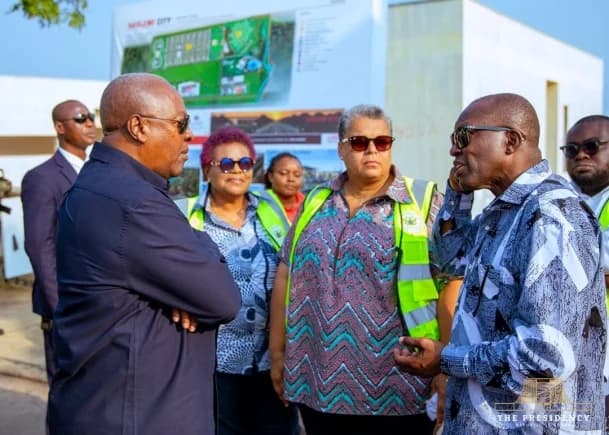
 Kojo Aduhene (right), CEO of LMI Holdings, briefing President John Dramani Mahama about the progress of work
  1. Home
  2. /Business
  3. /President Mahama Revives Saglemi Housing Project as Real Estate Sector Showcases Resilient Growth

President John Mahama has signaled a new era for Ghana’s housing sector, expressing firm confidence in the revival of the Saglemi Housing Project during a recent site visit. The project, which had been stalled for several years due to political transitions and legal disputes, is now set for completion under the management of LMI Holdings. This revitalization effort is a key component of the government's strategy to address the national housing deficit through strategic public-private partnerships. President Mahama urged prospective buyers to register early, noting that demand is expected to be high for the upcoming units.

According to the updated development schedule, LMI Holdings is expected to deliver the first 700 housing units by March 2027, with a target of 1,500 units completed by December 2027. Although the project's original scope was 5,000 affordable homes, the current phase focuses on delivering high-quality infrastructure, including modern amenities and high-speed internet. To further enhance the project's viability, the government is planning a railway connection to facilitate easier commuting for residents. Additionally, various financial institutions are in the process of creating specialized mortgage products to make these homes more accessible to the Ghanaian public.

The renewed energy in the national housing sector is mirrored by the success and resilience of private real estate entrepreneurs who continue to shape the industry. A notable example is Theresa Oppong-Beeko, whose career trajectory highlights the determination required to succeed in Ghana's competitive business landscape. After facing a significant setback at age 25 when her first business venture collapsed, leaving her with $2.5 million in debt, Oppong-Beeko returned to school to sharpen her business skills. Her subsequent pivot into the real estate sector and her eventual success serve as an inspiring benchmark for entrepreneurship within the industry.

As the Saglemi project transitions from a symbol of stalled investment to a beacon of urban development, the convergence of government-led initiatives and private-sector resilience points toward a robust outlook for the market. The successful delivery of these housing units and the continued growth of private developers like Oppong-Beeko are essential for providing sustainable, affordable housing solutions. Moving forward, the focus will remain on maintaining this momentum to ensure that infrastructure development continues to drive economic growth and improve the living standards of all Ghanaians.

Our Take

From the Team

Coming Soon

Our team will add key insights, trends, and actionable takeaways to help you stay informed faster.

This story touches markets covered on Anansi Intelligence ↗.

Related topic

John Mahama: Latest News & Updates →

More from business

Continue exploring similar stories

Augustus Goosie Tanoh — Presidential Advisor on the 24-Hour  Economy and Accelerated Export Development
business|Yesterday

Presidential Advisor Reveals $5.5 Billion Commitment to 24-Hour Economy as Ghana Targets Value-Added Trade and Industrial Resilience

Ghana’s economic landscape is undergoing a significant transformation, anchored by the 24-Hour Economy programme, which has successfully secured $5.5 billion in project commitments one year after its July 2025 launch. Presidential Advisor Augustus Goosie Tanoh revealed that these private sector-led investments, which include the $1.45 billion WAPCo Solar project and up to $3 billion in additional renewable energy ventures, are projected to create 1.7 million jobs by 2028. This initiative is a central pillar of President John Mahama’s administration, aimed at transitioning the nation from an import-dependent model to a self-sufficient, round-the-clock productive economy focused on manufacturing and agriculture. Parallel to these domestic investments, Finance Minister Dr. Cassiel Ato Forson is spearheading a strategic shift in Ghana’s trade relationship with China. Moving away from traditional raw material exports, the government is advocating for value-added trade, local processing, and technology transfer. To facilitate this, stakeholders from the financial and academic sectors have proposed a Ghana–China Zero-Tariff Fund. This dedicated financing mechanism is designed to help small and medium-sized enterprises (SMEs) overcome capital barriers and leverage China’s zero-tariff policies through innovative solutions like contract farming and warehouse financing. GOIL PLC CEO Edward Abambire Bawa further emphasized this need for local empowerment, calling for structured technology transfers and affordable long-term financing to bolster indigenous companies in the petroleum sector. However, this growth trajectory faces challenges from legacy financial issues and the need for institutional reform. The Ghana Mineworkers’ Union (GMWU) has intensified demands for the release of GH"380 million in provident funds locked in distressed financial institutions, highlighting the severe hardship faced by over 19,000 workers and retirees. Addressing these vulnerabilities, Stanbic Bank Executive Barbara Dede Ama Okai-Tettey argued at the Risk Summit 2026 that true institutional resilience requires a cultural shift beyond mere compliance toward proactive risk management and diversity of thought. Her call for strategic governance was echoed by the National Disaster Organisation (NADMO) and the Ministry of Finance, who recently launched capacity training with the UNDP to strengthen disaster risk financing against climate-related threats like flooding. Infrastructure and social responsibility also remain at the forefront of the national agenda. Togbe Afede XIV has announced new aviation and aerospace projects in Ho, including a pilot training school, while Star Oil CEO Philip Kwame Tieku is advocating for a modern coastal ferry service to improve regional connectivity. On the corporate front, MTN Ghana has pledged a GH"20 million support package to assist citizens returning from South Africa, focusing on long-term reintegration. As Ghana prepares for the Millennium Excellence Week 2026 and major trade fairs, the focus remains on building a robust, integrated economic framework that balances aggressive industrial investment with social protection and financial stability.

Tesla and Major Chinese EV Makers Recall 4 Million Vehicles Over Door Handle Safety Risks
business|Yesterday

Tesla and Major Chinese EV Makers Recall 4 Million Vehicles Over Door Handle Safety Risks

China is witnessing its largest-ever automotive recall, affecting over 4 million electric vehicles (EVs) due to safety concerns regarding 'hidden' or minimalist door handles. The recall is led by Tesla, which is recalling 2.98 million Chinese-made vehicles, but also includes prominent local manufacturers such as XPeng, Xiaomi, and Geely. The central issue involves the sleek, flush-mounted door handles that have become a signature aesthetic of modern EVs, which investigators found are difficult to locate or operate during emergencies, particularly after power failures or high-impact collisions. The safety crisis gained national attention in China following two fatal crashes involving Xiaomi-branded EVs. In these incidents, rescuers and passengers reportedly struggled to open the doors from the outside, raising alarms about the practical dangers of prioritizing minimalist design over accessibility. In response to the recall, manufacturers have committed to several mitigation strategies, including the application of internal warning labels to guide passengers and software updates designed to automatically lower windows after a crash occurs. However, industry experts such as Tu Le have cautioned that relying on software fixes for a fundamental hardware design flaw may be insufficient to ensure passenger safety in the long term. Regulatory authorities in China have already moved to prevent future occurrences by announcing a new mandatory standard. Beginning in January 2027, hidden door handles will be effectively banned in China unless they are equipped with a reliable mechanical manual release. This policy shift reflects a growing global scrutiny of EV design; Tesla is already facing similar investigations from regulators in the United States over handle failures. While it is currently unclear if the Chinese recall will trigger similar actions in other international markets, the move marks a significant turning point where safety functionality is being reasserted over aesthetic innovation in the world's largest electric vehicle market.

Dr James Condua Orleans-Lindsay (right), President, Ghana Real Estate Developers Association, addressing the meeting. Picture: ERNEST KODZI
business|Yesterday

GREDA Demands VAT Reform as Ghana’s Real Estate and Automotive Sectors Report Surging Market Interest

Ghana’s housing and automotive sectors are experiencing a significant surge in activity, evidenced by high-profile product launches and record-breaking public engagement at industry fairs. However, this growth is met with urgent calls from industry leaders for government intervention to address affordability and tax burdens. While the 2026 JoyNews-Republic Bank Habitat Fair and the Absa Auto Fair reported overwhelming turnouts and strong sales leads, the Ghana Real Estate Developers Association (GREDA) is sounding the alarm over the 20% Value Added Tax (VAT) on housing construction, which they claim is pricing many Ghanaians out of the market and threatening developer viability. During GREDA’s 2026 Annual General Meeting, President Dr. James Condua Orleans-Lindsay warned that the current VAT regime exacerbates the high cost of housing and urged the government to abolish the tax to foster affordability. Despite these fiscal hurdles, public appetite for real estate remains robust. Dan Adjetey Morhenu, Head of Mortgage Banking at Republic Bank, noted that the recent Habitat Fair saw massive engagement from potential homeowners across diverse income levels, with the bank offering flexible mortgage qualifications to accommodate those without fixed salary thresholds. This demand is also visible in the luxury segment with the progress of "The Venus" in Labone, a boutique development featuring Ghana’s first rooftop observatory, which has already reached 40% construction completion. In the automotive sector, the push for modernization is equally pronounced as brands transition toward sustainable technology and integrated financing. FET Auto Company Limited recently introduced a full range of Guangzhou Automobile Group (GAC) vehicles to the Ghanaian market, featuring both flagship SUVs and the AION electric vehicle series. At the launch, Chief of Staff Julius Debrah highlighted the shift towards green mobility, advocating for electric vehicle adoption to enhance environmental sustainability. This momentum was further evidenced at the Absa Auto Fair at Ghud Park, where leading dealers secured significant sales and customer leads, supported by tailored financing solutions from Absa Bank. As Ghana navigates this period of industrial expansion, the focus is shifting toward long-term sustainability and comprehensive urban planning. Beyond tax relief, GREDA has called for a more holistic approach to land acquisition and infrastructure to mitigate flooding and rising material costs. Meanwhile, the automotive industry is looking to capitalize on Ghana’s strategic importance in West Africa by strengthening local partnerships. The convergence of high demand for assets and the necessity for fiscal reform suggests that while the private sector is ready to invest, the pace of growth will depend on the government’s ability to balance revenue collection with the pressing need for affordable living and green energy adoption.

Ghana’s Capital Markets Surge as PETROSOL Oversubscribes GH₵100m Bond and SEC Opens Virtual Asset Sandbox
business|Yesterday

Ghana’s Capital Markets Surge as PETROSOL Oversubscribes GH₵100m Bond and SEC Opens Virtual Asset Sandbox

Ghana’s financial landscape is undergoing a significant transformation, marked by robust performance on the Ghana Stock Exchange (GSE) and a pioneering move toward digital asset regulation. Abena Amoah, Managing Director of the GSE, recently revealed that investors earned a staggering GH¢37 billion in dividends over the past year, with an additional GH¢800 million paid out in coupons to holders of corporate bonds and commercial papers. This surge in returns underscores the capital market's growing role in wealth creation and long-term business financing. Highlighting this investor appetite, PETROSOL Platinum Energy PLC successfully debuted its maiden GH₵100 million corporate bond, which achieved a 178% oversubscription. The bond, listed on the Ghana Fixed Income Market, attracted intense interest, particularly for its four-year tranche, which was oversubscribed by 229%, providing the oil marketing firm with capital to expand its retail network of 109 stations. Simultaneously, the Securities and Exchange Commission (SEC) is paving the way for the future of finance by admitting several innovative firms into its Virtual Assets Regulatory Sandbox. Fintech firm WeWire has been selected to pilot the tokenization of trade finance, a move intended to streamline cross-border liquidity and settle trade instruments as digital tokens. WeWire’s entry into the sandbox follows its previous participation in the Bank of Ghana’s regulatory framework, signaling a shift toward harmonized digital asset oversight. Similarly, Mansu Technologies, the firm behind the "Crypto Made Easy" platform, has secured its place in the SEC sandbox to focus on virtual asset brokerage. Both companies aim to enhance trust and regulatory compliance within the burgeoning cryptocurrency and blockchain sectors, aligning with broader national trends of tokenizing traditional instruments like Treasury bills. This rapid digital and financial expansion is also being mirrored in Ghana’s media and entrepreneurship space. The 'Konnected Minds' podcast, hosted by Derrick Abaitey, has recently topped Apple Podcast charts in the entrepreneurship and business categories across multiple countries, including Ghana, Nigeria, and Qatar. This global reach highlights a growing international interest in African-led business narratives. However, the growth of the digital economy has prompted stricter oversight regarding data security. The Data Protection Commission has designated 2026 as the "Year of Enforcement" to ensure businesses comply with the Data Protection Act of 2012, following high-profile privacy breaches and a push for the new Data Harmonisation Bill. As Ghana navigates this dual path of traditional market growth and digital innovation, the integration of fintech into regulated frameworks is expected to lower the costs of cross-border trade and provide more accessible investment avenues for the public. With pension funds now managing over GH¢120 billion in assets, officials like the GSE’s Abena Amoah are urging more local businesses to pivot toward the capital markets for sustainable funding. The success of PETROSOL’s bond and the formalization of virtual asset pilots suggest a maturing financial ecosystem that balances aggressive innovation with necessary regulatory safeguards.

All
africa
business
education
entertainment
health
news
politics
sports
technology