••
President Mahama Announces Listing of 10 State-Owned Enterprises on GSE as Private Sector Activity Hits Economic "Inflection Point"
•3 min read•14 sources
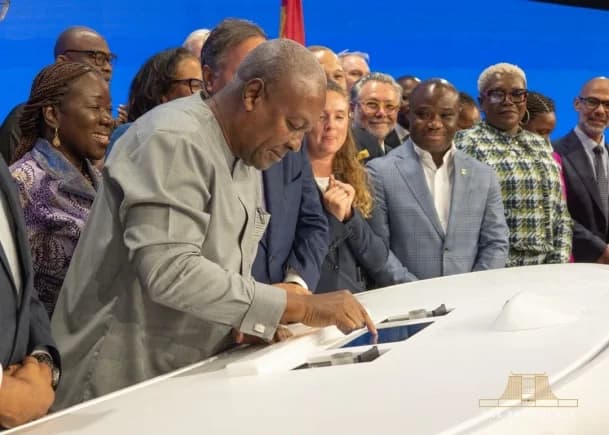
President John Dramani Mahama has announced a landmark policy to list 10 state-owned enterprises (SOEs) on the Ghana Stock Exchange (GSE), a move designed to curb political interference and attract significant private investment. Speaking at a series of high-level forums including a discussion in New York and a session at NASDAQ, the President highlighted that this initiative follows a dramatic turnaround in SOE performance, with collective profits rising to nearly GH₵19 billion after years of losses. Mahama emphasized that Ghana is now a premier destination for American investors, citing the country's political stability and a surge in Foreign Direct Investment (FDI), which jumped from $640 million in 2024 to $2.6 billion by the end of 2025. He further linked domestic prosperity to global stability, urging a resolution to the US-Iran conflict to ease pressure on local interest rates and facilitate long-term financing for Ghanaian businesses.
This government-led shift coincides with what Vish Ashiagbor, Country Senior Partner at PwC Ghana, describes as an economic "inflection point." Speaking at the UK-Ghana Trade & Investment Summit 2026, Ashiagbor noted that the private sector is increasingly taking the lead in driving economic activity, moving away from a traditional reliance on government initiatives. To navigate this transition, experts are calling for a more resilient corporate culture. Felix Addo, President of the Chartered Institute of Restructuring and Insolvency Practitioners (CIRIP), recently advocated for business rescue over liquidation to protect jobs and revenue. This sentiment was echoed at the Telecel Business Runway in Takoradi, where Dr. Daniel McKorley of the McDan Group warned SMEs against over-dependence on founders, urging them to build robust corporate systems to survive in an evolving market.
On the regional front, investment strategies are shifting from theoretical discussions to tangible execution. The Volta Economic Forum recently transitioned its focus to "Investment Execution," highlighting successful projects like the Zen Palms Beach Resort and new sisal farming initiatives. Simultaneously, the Eastern Region is preparing to host World Tourism Day 2026 under the theme "Digital Agenda and Artificial Intelligence to Redesign Tourism." This event, alongside the Eastern Expo 2026, aims to showcase the economic potential of the region's 33 municipal and district assemblies. These efforts are being integrated into the national "24-Hour Economy" agenda, with the Secretariat supporting the upcoming 6th Inter Tourism Expo in Cape Coast to position Ghana as a round-the-clock investment hub.
As Ghana’s economy grew by 6% in 2025 and 6.4% in early 2026, the focus has turned toward sustaining this momentum through digital transformation and value retention. President Mahama has called for increased local processing of agricultural products and technology-driven ventures to ensure that the benefits of the African Continental Free Trade Area (AfCFTA) are fully realized. By combining state-led reforms, such as the GSE listings, with regional investment drives and private-sector adaptation, Ghana aims to solidify its position as a gateway to the 1.4 billion-person African market, ensuring that macroeconomic stability translates into tangible improvements for local businesses and communities.
Related topic
John Mahama: Latest News & Updates →
