••
KNUST Consortium Secures €300,000 Grant to Develop Locally Manufactured Herbal Pain Relief Tablets
•2 min read•1 source
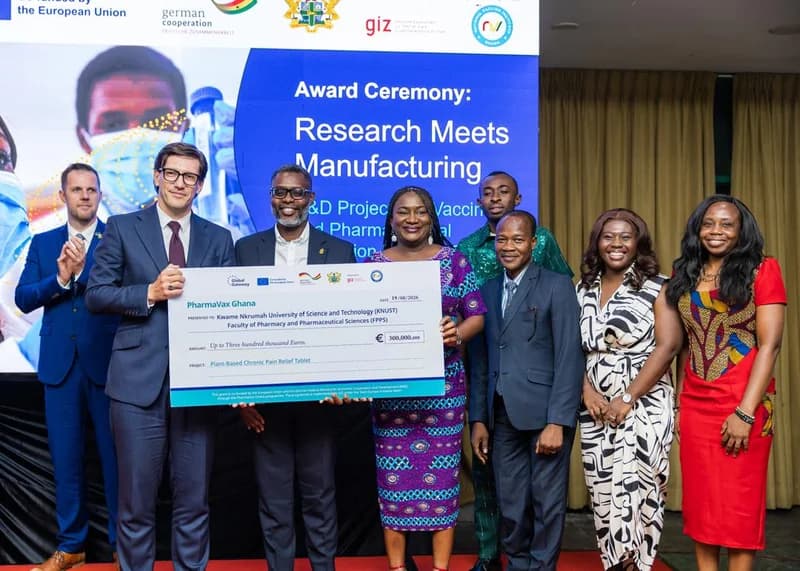
The Kwame Nkrumah University of Science and Technology (KNUST) has taken a significant step toward revolutionizing Ghana’s pharmaceutical industry, with its Faculty of Pharmacy and Pharmaceutical Sciences securing a €300,000 grant to develop a locally manufactured herbal pain relief medicine. Awarded under the PharmaVax Ghana Programme, the grant was officially announced during a ceremony on August 19, 2026, featuring stakeholders from the National Vaccine Institute and the Deutsche Gesellschaft für Internationale Zusammenarbeit (GIZ). This initiative represents a milestone in the commercialization of indigenous medical research, aiming to bridge the gap between traditional herbal remedies and modern pharmaceutical standards. The two-year project is a collaborative effort involving KNUST, Aspee Pharmaceuticals, and the Biotechnology and Nuclear Agriculture Research Institute (BNARI). The consortium intends to optimize an existing herbal pain remedy, which has been the subject of nearly a decade of academic research, into a sophisticated sustained-release tablet formulation. By partnering with industry leaders like Aspee Pharmaceuticals for large-scale production, the project ensures that the transition from laboratory discovery to market-ready product is seamless and commercially viable for the Ghanaian market. One of the core innovations of this project is the integration of plant tissue culture techniques to address the chronic issue of raw material shortages that often plagues the herbal medicine sector. By utilizing advanced agricultural biotechnology provided by BNARI, the consortium can ensure a consistent and sustainable supply of the medicinal plants required for manufacturing, independent of seasonal or environmental fluctuations. This approach not only stabilizes the production chain but also showcases the potential of multidisciplinary research in solving industrial bottlenecks within the health sector. Beyond the immediate goal of providing an affordable and effective pain relief option, the project is expected to have far-reaching socio-economic impacts. Experts involved in the initiative highlighted that the successful rollout of the sustained-release tablets will create local job opportunities and significantly reduce Ghana’s reliance on imported analgesics. As the country continues to strengthen its local manufacturing capacity, this KNUST-led project serves as a blueprint for how academic-industry partnerships can enhance healthcare access and stimulate economic growth through home-grown scientific innovation.