••
King Charles Issues Stern Warning to AI Executives Over ‘Existential Dangers’ of Misused Technology
•2 min read•2 sources
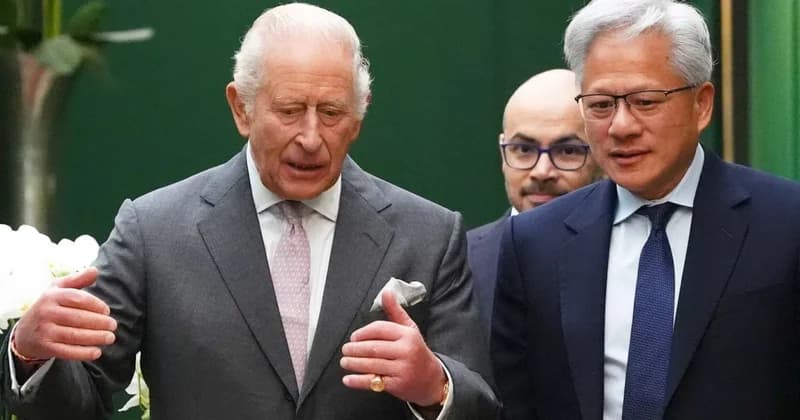
King Charles has cautioned global technology leaders against the "existential dangers" of artificial intelligence during a high-profile summit held at Dumfries House. Addressing a room of prominent industry executives and policymakers, the monarch emphasized that while AI offers transformative potential, the consequences of the technology falling into the "wrong hands" could be catastrophic for humanity. The summit, which included UK AI Minister Kanishka Narayan and representatives from pioneering firms such as OpenAI, Anthropic, and Nvidia, underscores the growing international concern regarding the rapid and often unchecked evolution of machine learning.
The King’s address called for an urgent establishment of shared principles to guide the future of AI development, insisting that the technology must be designed to serve humanity rather than threaten it. His sentiments were echoed by Jensen Huang, CEO of Nvidia, who stressed the critical importance of safety and responsible innovation. Sir Demis Hassabis, co-founder of Google DeepMind, also contributed to the discourse, highlighting the unprecedented speed at which AI capabilities are advancing and the technical challenges involved in maintaining control over autonomous systems.
The gathering at Dumfries House comes amid a broader, often polarizing debate within the tech community and government circles. While some industry voices are advocating for immediate and stringent government oversight to mitigate long-term risks, others argue that fears of an existential threat are being exaggerated, potentially overshadowing more immediate issues like algorithmic bias and data privacy. Critics have noted that focusing on hypothetical future catastrophes might distract from the real-world harms currently being facilitated by existing AI technologies.
As the global race for AI supremacy continues, the summit highlights a pivotal moment where traditional institutions are seeking to exert influence over Silicon Valley’s trajectory. The call for a unified framework suggests that the next phase of AI development will likely involve greater collaboration between private innovators and public stakeholders. For the international community, these discussions signal a shift toward a more regulated digital landscape where the "existential" label is no longer confined to science fiction but is a core consideration of modern governance.