••
Ghana Institution of Engineering Inducts 183 New Members Amid Urgent Calls for Infrastructure Reform and Environmental Action
•2 min read•2 sources
The Ghana Institution of Engineering (GhIE) has officially welcomed 183 new members into its professional fold during its 49th Induction Ceremony held on August 25, 2026. Addressing the new inductees, the President of the Institution, Ing. Dr. Ludwig Annang Hesse, emphasized the critical role engineers play in safeguarding society and driving national development. He urged the professionals to maintain the highest levels of integrity and to view their induction not just as a career milestone, but as a lifelong commitment to public safety, ethical practice, and continuous professional development.
The ceremony underscored the urgent need for engineering expertise to tackle Ghana's mounting infrastructure and environmental crises. Dr. Hesse specifically highlighted the devastating effects of illegal mining (galamsey), frequent building collapses, and the persistent threat of flooding across the country. He referenced the 2026 Ghana Infrastructure Report Card, which issued a sobering "D3" grade for the nation’s current state of infrastructure. This assessment serves as a call to action for the newly inducted engineers to adopt proactive measures and advocate for stronger regulatory enforcement to protect both the environment and the public good.
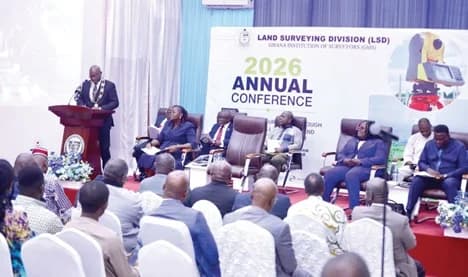
In a parallel call for professional advancement, the Land Surveying Division of the Ghana Institution of Surveyors (GhIS) recently held its annual conference in Accra, focusing on the theme "Advancing Land Surveying through Innovation, Collaboration and Stakeholder Engagement." During this event, Dr. Kwadwo Yeboah, CEO of the Land Use and Spatial Planning Authority (LUSPA), tasked land surveyors to embrace "spatial intelligence" and modern technologies such as Artificial Intelligence (AI) and Geographic Information Systems (GIS). He argued that integrating these tools is essential for effective national planning and for addressing modern urban pressures like unplanned settlements and flood risks.
Both institutions converged on the necessity of interdisciplinary collaboration and continuous learning to ensure professional relevance. As Ghana faces complex challenges related to urbanization and climate change, leaders from both the GhIE and GhIS stressed that professionals must adapt to rapidly changing technological and societal demands. The call to action for these new and seasoned practitioners is clear: they must uphold the dignity of their professions while leveraging innovative technology to build a more resilient, safe, and sustainable future for the country.
