••
Ghana to ban raw mineral exports and rice imports by 2030
•2 min read•2 sources
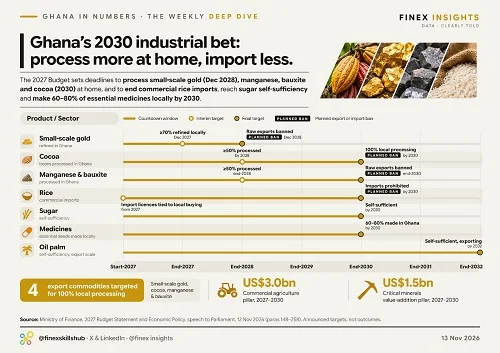
The Ghana government has announced a comprehensive industrial policy within the 2027 budget that seeks to end the export of raw minerals and the commercial importation of rice by 2030. This strategic pivot, presented as a major job-creation initiative, aims to transform the nation from a primary commodity exporter into an industrial hub through aggressive local value addition and import substitution.
Central to this plan is a $1.5 billion investment earmarked for the processing of critical minerals. The government intends to ensure that 100% of Ghana’s cocoa, manganese, and bauxite are processed domestically by the turn of the decade. In the shorter term, the policy sets a December 2027 deadline for the local refining of at least 70% of gold produced by small-scale and artisanal miners, a move designed to retain more value from the country’s significant gold reserves.
On the agricultural front, the 2027 budget introduces a phased approach to reducing dependence on foreign food. Gradual restrictions on commercial rice imports are scheduled to commence in 2027, with the ultimate goal of achieving total rice self-sufficiency by 2028. Furthermore, the industrial roadmap includes support for the pharmaceutical sector and sets a target for palm oil self-sufficiency by 2032, signaling a broad effort to secure essential supply chains.
Economists and market analysts have reacted to the budget with a mixture of optimism and caution. While the focus on structural transformation and fiscal discipline has been applauded, experts warn of significant execution risks. Key concerns include the need for a stable and affordable energy supply to support new factories, as well as the requirement for a clear regulatory framework to manage the transition. Some observers also noted that while the plan is ambitious, more detail is needed regarding the implementation of the proposed 24-hour economy within these industrial sectors.
Live rates
Ghana gold price →