••
Auditor-General reveals GH‵117.9bn in financial irregularities since 2015
•2 min read•1 source
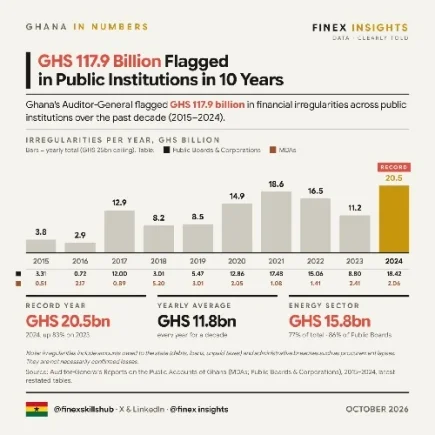
Ghana’s Auditor-General has reported a cumulative total of GH‵117.9 billion in financial irregularities spanning the decade from 2015 to 2024. The findings, synthesized from multiple annual audit reviews, highlight persistent and systemic weaknesses in the country’s public financial management. The most recent data indicates a sharp escalation in these figures, with the 2024 reporting period seeing an 83% jump as the energy sector and various public boards dominated the list of fiscal infractions. These irregularities reflect a broad range of issues including cash losses, payroll errors, and non-compliance with established procurement regulations.
Public boards were identified as the primary drivers of recent losses, accounting for approximately GH‵18.42 billion in the 2024 cycle alone. The Electricity Company of Ghana (ECG) was specifically cited for significant lapses, with auditors pointing to substantial problems in procurement processes and financial reporting. These failures often involve the acquisition of goods and services without following the proper competitive bidding processes or failing to provide adequate documentation for multi-million cedi transactions. The report suggests that without more rigorous oversight, these state-owned enterprises will continue to serve as a drain on national resources.
In response to these findings, financial experts and policy analysts are advocating for a total overhaul of internal oversight mechanisms. Key recommendations include enhancing the independence of internal audit units within state agencies and providing continuous, mandatory training for procurement officers to ensure they stay abreast of the Public Procurement Act. Furthermore, there is a growing call for the strict enforcement of financial controls and legal sanctions against officials responsible for these losses. Strengthening these institutional safeguards is considered critical to reducing the high volume of irregularities and ensuring that public funds are managed with greater transparency and accountability.
Live rates
Dollar to cedi rate →