••
Peter Cardinal Turkson urges 2,806 CUG graduates to lead with integrity
•2 min read•1 source
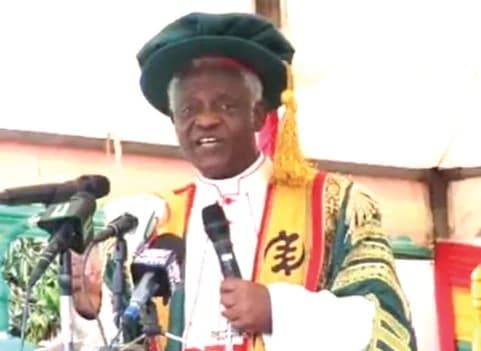
The Chancellor of the Catholic University of Ghana (CUG), Peter Cardinal Appiah Turkson, has called on the university's latest cohort of graduates to look beyond their academic achievements and prioritize moral character in their professional lives. Speaking at the institution's 25th Congregation in Sunyani, the Cardinal addressed 2,806 graduates, urging them to champion truth, integrity, and compassion as they enter a world increasingly defined by misinformation and political division. The ceremony marked a historic milestone for the university, celebrating its first-ever PhD graduate alongside a record-breaking enrollment of 3,648 new students for the current academic year.
Cardinal Turkson emphasized that academic credentials alone are insufficient to address the complex challenges facing modern society. He introduced four foundational ethical principles—vulnerability, unlearning, compassion, and answerability—as essential tools for the graduates. According to the Chancellor, "vulnerability" refers to an openness to new perspectives, while "unlearning" involves discarding outdated or harmful biases. He argued that these traits, combined with deep compassion and a sense of responsibility to both God and society, are necessary for fostering the dialogue and collaboration needed to solve global issues.
The Vice-Chancellor of CUG, Professor Mathew Glover Addo, highlighted the university's significant growth, noting that the record-high enrollment reflects increasing public confidence in the institution’s holistic approach to education. Amidst these successes, however, Professor Addo used the occasion to call for greater government intervention in the private tertiary sector. He advocated for enhanced support mechanisms, such as research grants and infrastructure development assistance, to help private universities continue providing high-quality education that complements the state's efforts.
The 25th Congregation serves as a reminder of the Catholic University of Ghana’s evolving role in the nation’s educational landscape, transitioning from its foundational stages to producing high-level researchers and a large, ethics-focused workforce. As the 2,806 graduates depart, the institution’s leadership remains focused on balancing expansion with the rigorous moral standards advocated by Cardinal Turkson. The emphasis on ethical responsibility over mere certification sets a clear expectation for the new alumni to act as agents of positive change in their respective fields.

