••
Finance Minister Ato Forson Signals Shift to Disciplined Debt Management and Value-Added Trade
•3 min read•11 sources
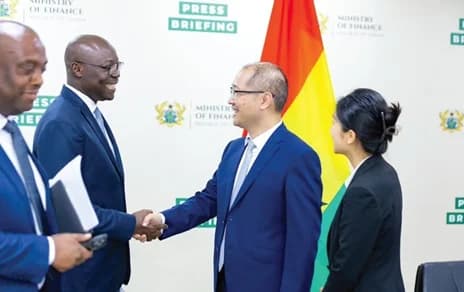
Ghana’s Minister for Finance, Dr. Cassiel Ato Forson, has announced a more disciplined approach to national development financing, asserting that the government will no longer borrow simply because funds are available. Speaking at the Fifth Session of the Ghana–China Joint Commission on Economic, Trade and Technical Cooperation, Dr. Forson emphasized that future loans will be reserved for projects that are economically justified, transparently procured, and capable of driving productivity or job creation. This strategic shift aims to maintain debt sustainability and avoid the recurrence of past economic crises. Simultaneously, Dr. Forson called for a transformation in trade relations with China, pushing for a move from raw material exports toward local value addition and processing, particularly in the cocoa sector, as imports from China reached GH¢57.6 billion in 2025.
Adding weight to the call for structural change, economist Professor Godfred Bokpin and the IMANI Centre for Policy and Education have urged the government to reduce its heavy reliance on natural resource exports. During the 2026 Students and Young Professionals African Leadership Academy, Professor Bokpin argued that sustainable development can only be achieved by transitioning to an economy rooted in innovation, ideas, and digitization. IMANI President Franklin Cudjoe echoed these sentiments, criticizing policy inconsistencies that hinder economic resilience and advocating for homegrown strategies that prioritize evidence-based policymaking and tax incentives for startups to tackle rising unemployment.
Despite discussions of economic growth and slowing inflation, organized labor has raised concerns regarding the actual cost of living for citizens. Dr. Kwabena Nyarko Otoo, Deputy General Secretary of the Trades Union Congress (TUC), cautioned that a declining inflation rate does not mean a fall in the prices of goods and services. He clarified that while the rate of price increases has slowed over the past 18 months, the absolute cost of essentials remains high, creating a persistent gap between income growth and household expenses. This sentiment was mirrored at the Risk Summit 2026, where Stanbic Bank President Barbara Dede Ama Okai-Tettey urged institutions to look beyond simple risk compliance and focus on proactive resilience and cultural shifts to navigate global economic uncertainties.
Looking toward the future, the National Emerging Leaders Economic Forum (NELEF) 2026 is advocating for measurable results in youth empowerment and digital transformation. Founder Daniel Asomani has challenged leaders to provide clear timelines for job creation and supported calls to lower the presidential age requirement to 35 to ensure younger voices are represented in governance. In the private sector, the Advertising Association of Ghana (AAG) is also embracing change, with President Andrew Ackah highlighting at the 18th Gong Gong Awards that AI must be leveraged to enhance rather than replace human creativity. As the nation navigates these transitions, the Ministry of Foreign Affairs is working to resolve technical disruptions to the online passport application platform, highlighting the ongoing need for robust digital infrastructure to support Ghana’s evolving economic landscape.


