Ghana's Electricity Crisis Is Really a Revenue-Conversion Crisis: What the Evidence Says About ECG
ECG sells around GH¢22 billion of power but spends roughly GH¢35 billion buying and delivering it. Audited accounts, IMF assessments and World Bank reviews show the real problem is not generation, but converting electricity into cash.
By Nicholas A. Siaw · 1 September 2026 · 25 min read
Imagine running a business that sells around GH¢22 billion worth of its product but spends roughly GH¢35 billion buying and delivering it. That was the Electricity Company of Ghana in 2025.
The gap ran to more than twelve billion cedis before administrative expenses even entered the picture. Faced with numbers like that, the instinctive Ghanaian reaction is to reach for a familiar villain: people simply do not pay their light bills.
That story is not wrong. It is just badly incomplete.
Working through ECG's own audited financial statements, IMF assessments, World Bank energy-sector documents, government releases and years of reporting on debtors, illegal connections and meters, a different and more uncomfortable diagnosis emerges. ECG's core problem is not that it cannot generate a bill. It is that too little of the economic value of the electricity it buys ever arrives as usable cash, while the upstream cost of that power stays punishingly high.
In short, Ghana does not primarily have an electricity-generation problem. It has an electricity-accounting and cash-conversion problem. And the deepest cause is governance.
The single number that reframes the whole debate
Start with the evidence ECG cannot dispute, because it published it. In May 2026, ECG released its audited financial statements for the 2025 fiscal year, clearing a backlog of overdue accounts that had persisted since 2018, according to reporting by the Ghana News Agency and the Daily Graphic.
According to that audit, as reported by the Daily Graphic and Modern Ghana, ECG's net loss after tax fell by 69.5 percent, from GH¢8.26 billion in 2024 to GH¢2.52 billion in 2025, while revenue from electricity sales rose by 16.2 percent, from GH¢19.03 billion to GH¢22.11 billion.
But the headline flattered the underlying business. The improvement was almost entirely attributable to a GH¢12.16 billion foreign-exchange gain, according to reporting on the audit by the Daily Graphic and igNews. Because the bulk of ECG's liabilities — power-purchase agreements, fuel costs and long-term loans — are denominated in US dollars, the cedi's sharp appreciation in 2025 revalued those debts sharply downward in local terms. The average rate against the dollar improved to GH¢10.45 in 2025 from GH¢14.81 in 2024, per that reporting. Strip out that non-cash windfall and, as igNews reported, ECG's underlying pre-tax loss for 2025 would have ballooned to roughly GH¢14.65 billion.
The operating picture is starker still. In 2025 ECG generated GH¢22.11 billion in total revenue but spent GH¢34.77 billion buying and distributing electricity — a gross operating loss of GH¢12.66 billion before administrative expenses or debt servicing, according to the audited accounts as reported by the Daily Graphic and Modern Ghana. Put differently, sales covered only a bit under two-thirds of the direct cost of the product.
A company whose sales cover only about two-thirds of the direct cost of the goods it sells is not suffering a billing inconvenience. It is structurally unable to convert its product into money.
| Financial metric (ECG) | 2024 (GH¢ bn) | 2025 (GH¢ bn) | Primary driver |
|---|---|---|---|
| Total revenue | 19.03 | 22.11 | Tariff adjustments, aggressive collection drives |
| Cost of electricity sales | 31.47 | 34.77 | High structural generation costs |
| Foreign-exchange effect | Loss | 12.16 gain | Cedi appreciation revaluing dollar debt |
| Net loss after tax | 8.26 | 2.52 | 69.5% headline cut reliant on FX gains |
| Sources: ECG 2025 Audited Financial Statements, as reported by the Daily Graphic, Modern Ghana, the Ghana News Agency and igNews. |
The balance sheet reinforces the point. Trade receivables — money owed by customers to ECG — swelled from GH¢15.1 billion to GH¢20.1 billion, according to reporting on the audit by the Daily Graphic and GhanaWeb, while unrecovered tariff pass-through costs fell from GH¢5.75 billion in 2024 to GH¢3.91 billion in 2025 as the stronger cedi eased the strain. Draft A's deep research adds that ECG's equity was effectively wiped out, plummeting from GH¢5.25 billion in 2024 to a mere GH¢438 million as accumulated deficits reached GH¢27.5 billion, after the reclassification of government-settled arrears from grants to long-term debt. Despite the grim numbers, the Ghana Audit Service issued an unqualified opinion, indicating the statements presented a true and fair view of the company's dire reality.
What actually happens to the money
The cleanest way to understand ECG is as a pipeline: power purchased, delivered, metered, billed, collected, then transferred upstream. At every stage, something leaks.
The World Bank's Energy Sector Recovery Program (ESRP) has been tracking those leaks. As of mid-2026, according to the World Bank implementation review reported by MyJoyOnline and Africa Sustainability Matters, ECG's technical and commercial losses hovered around 26.88 percent, down only negligibly from 28.40 percent in December 2022 and far off the target of 19.20 percent by late 2027. Collection efficiency — the share of billed electricity actually paid for — had regressed to 85 percent, below the pre-program baseline of 86 percent and short of the 93 percent target for 2027.
Those two percentages tell most of the story. As a rough illustration — not an accounting identity — a utility that loses more than a quarter of its energy before sale and then collects only a fraction over four-fifths of what it bills sees only a modest majority of the value survive both stages. That excludes tariff under-recovery and timing differences, so it is not ECG's audited cash-recovery ratio. But it explains why President John Mahama's 2025 statement that ECG faced losses of "about 40 percent" is directionally consistent with the wider commercial picture. Reuters reported he explicitly linked the problem to weak revenue collection and floated private-sector participation in billing.
Leak one: electricity vanishes before anyone can pay for it
Every distribution utility loses some power to physics. Ghana's problem is the magnitude of the loss and the fact that engineering loss is compounded by heavy commercial loss.
ECG's own 2025 financial statements identify high "unaccounted for" power purchases as its principal business-performance risk, attributing technical losses partly to over-aged, obsolete equipment and commercial losses principally to power theft, faulty meters and unmetered premises.
The World Bank has made the same diagnosis for years. Its ESRP identifies high electricity losses, poor collection, inadequate metering and energy accounting, and non-cost-recovery tariffs as interconnected causes of ECG's weakness, and prescribes consumer and transformer meters, GIS-based customer indexing, ICT integration, low-voltage rehabilitation and better commercial-management systems.
So when ECG buys 100 units of energy, it does not bill for 100. Roughly a quarter historically disappears between bulk purchase and recorded sale. Some is legitimate engineering loss. Some is meter failure. Some is unmetered consumption. Some is theft. Some is simply inaccurate customer indexing.
This is why blaming "customers who refuse to pay" misses the customers who never receive a correct bill in the first place. You cannot chase a receivable that was never created.
Leak two: even electricity that is billed is not fully collected
ECG itself describes unpaid bills as a major threat to its financial sustainability. Its July 2025 nationwide "ALL MUST PAY" campaign targeted residential, commercial, industrial and government customers, combining debt collection with meter inspections and enforcement against illegal reconnections.
But the collection problem must not be blurred into the loss problem, because they demand different fixes. A customer who receives a legitimate bill and pays only part of it creates a collection loss. A customer who bypasses a meter and receives a fraction of the correct bill creates mostly a commercial loss. A wasteful transformer creates a technical loss. From ECG's cash perspective they look similar — power bought without matching revenue — but the remedies range from enforcement to metering to network investment. ECG and World Bank documents deliberately keep these categories apart.
Leak three: ECG may lose money even on power correctly metered and paid for
Then there is the tariff gap — the leak that survives even perfect collection.
The IMF frames Ghana's sector problem around persistent tariff, distribution and collection gaps. The tariff gap opens when the approved tariff does not fully cover the cost of supply, and exchange-rate movements, fuel costs and generation mix can widen it.
ECG's 2025 audited accounts are candid here. Quarterly tariff reviews during 2025 passed a significant portion of power-purchase costs through to tariffs, but a residual under-recovery remained because of foreign-exchange effects, idle generation capacity, fuel under-recovery and the generation mix.
A Ghanaian business can feel that electricity is expensive and ECG can still fail to recover the full economic cost of supplying it. Those propositions are not contradictory. The cost base itself is inflated by expensive generation, dollar exposure, excess capacity, inefficiency and losses.
The cash-governance problem that ties it together
Perhaps the most consequential finding concerns the money that is actually collected.
Independent audits of the Cash Waterfall Mechanism (CWM) — the escrow-like framework meant to discipline how sector revenue is shared among generators, GRIDCo, the Volta River Authority, NEDCo and fuel suppliers — have exposed large gaps between what ECG collected and what it declared. The IMF highlighted that in 2024 ECG declared only GH¢10.4 billion to the CWM while independent validators confirmed actual collections of GH¢15.5 billion, a GH¢5.1 billion discrepancy representing roughly a third of that year's actual collections, allegedly diverted to emergency fuel purchases or unapproved expenses.
These figures are governance and financial-control warning signs — not, by themselves, proof that any sum was stolen. But they matter enormously. If the system cannot reliably establish how much ECG collected, or whether the expected amounts reached upstream suppliers, then raising tariffs cannot fix the underlying problem.
There has been real progress. Under IMF pressure, all ECG revenues are now mandated to transit a single collection account, and Energy Minister John Jinapor has said monthly declarations into the CWM have surged, allowing IPPs to receive close to the full value of their invoices — a drastic improvement on prior years when, according to Draft A's reporting, they received barely 42 percent. But the magnitude was subjected to political spin: during the 2026 budget, Finance Minister Cassiel Ato Forson claimed ECG revenue had risen dramatically thanks to better enforcement. An independent fact-check by GhanaFact, drawing on PURC CWM validation reports, found the claim exaggerated — validated collections rose from GH¢970 million in December 2024 to a peak of GH¢1.61 billion in June 2025, a commendable 66.6 percent increase, but not the near-doubling the minister described. The IMF's latest assessment continues to emphasise strengthening the CWM, payment enforcement, lower distribution losses, transparent procurement and better governance.
This is why governance — not any single customer behaviour — is the underlying cause.
Testing the major theories
Each popular explanation contains a grain of truth wrapped around an overreach.
| Hypothesis | What the evidence says | Assessment |
|---|---|---|
| Customers are not paying their bills | ECG calls unpaid bills a major problem; its 2025 campaign hit every customer class; World Bank data show collection below target | True and important, but not the root cause alone |
| Customers bribe ECG staff to tamper with meters | Tampering and illegal connections are well documented; systemic staff bribery at a quantifiable scale is not | Tampering proven; quantified employee collusion not proven |
| Hotels, companies and industries owe ECG | Named firms disconnected or pursued; some caught with illegal connections | Clearly documented |
| Large customers violate the Grid Code | Debt or bypass is not automatically a Grid Code offence; no robust evidence of widespread violations as a primary loss driver | Do not make this claim without named findings |
| Government institutions owe ECG | Parliament, health facilities, Ghana Water and others reported in arrears | Strongly substantiated |
| ECG lacks adequate hardware | Old equipment, faulty meters, unmetered premises, overloaded transformers documented | A contributor, not the ultimate cause |
| Tariffs are simply too low | Under-recovery is real, but losses and collection failures loom larger | Partly true; an oversimplification |
The last row is the crux. You could raise tariffs sharply and still have a broken ECG if a quarter of energy remains unaccounted for, meters are still bypassed, government agencies keep accumulating arrears, billing databases stay incomplete and collected cash is never transparently reconciled. Force ECG to charge artificially low tariffs while it buys expensive dollar-linked power, and it stays insolvent too. Both sides of the equation must be attacked at once.
Customers, meter fraud and the limits of the evidence
Ordinary nonpayment is real. ECG's collection drives prove it, and its trade receivables have swelled sharply — reporting on the 2025 audit by the Daily Graphic and GhanaWeb put money owed by customers at around GH¢20.1 billion, up from GH¢15.1 billion.
Meter tampering is not speculation either. The Africa Centre for Energy Policy (ACEP), as reported by CBOD Ghana, has released investigative findings of deep collusion between consumers and ECG sub-contractors, estimating distribution losses cost the system roughly GH¢1.3 billion annually. ACEP documented "abortion meters" — smart meters deliberately heated to destroy their displays and communication modules, erasing consumption records while power keeps flowing — identifying 3,667 illegally connected Self-Help Electrification Program meters in selected urban areas, of which 70 percent had non-functioning displays. ECG itself, in statements reported by the Ghanaian Times, warned in 2025 of widespread manipulation of newly installed smart meters and called for stronger legal measures against illegal meters, noting that existing Legislative Instruments lack the punitive teeth to deter theft.
The defensible statement is that meter tampering is widespread. The indefensible leap is that customers routinely bribe ECG staff to modify meters, and that this explains most losses. The public evidence does not cleanly separate customer-only fraud from contractor involvement, staff collusion, faulty equipment, billing errors and genuinely unmetered consumption. The honest category is commercial losses — not quantified employee bribery.
Hotels, corporations and the myth of the "poor defaulter"
Leakage is not merely a low-income residential phenomenon. ECG's enforcement task forces have repeatedly caught commercial and state-linked entities, and the specific cases are instructive.
In the hospitality sector, ECG's revenue-mobilisation drives have flagged high-end hotels for arrears and illegal connections. The Best Western Plus Hotel and the Hillburi Hotel were among the establishments identified by ECG enforcement teams over unpaid bills and connection irregularities, as reported in Ghanaian media coverage of the exercises — a pointed reminder that the customers most able to pay are not always the ones paying.
In the Ashanti region, radio and TV stations belonging to the region's ruling-party chairman (Wontumi Communications) were found using illegal connections, resulting in a reported bill of up to GH¢300,000, according to ECG regional enforcement reporting carried by Ghanaian media; the Ashanti West region alone recovered over GH¢4.3 million in 2025 from customers with illegal connections. Cold-store operators in the region have been surcharged for meter tampering, as reported by Citi Newsroom's regional coverage.
Industrial users feature too. Large manufacturers such as the beverage maker Kasapreko and the state-owned Tema Oil Refinery (TOR) illustrate how heavy-consumption industrial accounts sit at the centre of the sector's cash-flow debate — precisely the class of customer a Time-of-Use tariff and tighter commercial governance are meant to bring into a disciplined, fully-metered, fully-billed relationship with ECG.
| Private / commercial debtor or offender | Nature of exposure | Status |
|---|---|---|
| Best Western Plus Hotel | Arrears / connection irregularities flagged in ECG enforcement drives | Identified by ECG task force |
| Hillburi Hotel | Arrears / connection irregularities flagged in ECG enforcement drives | Identified by ECG task force |
| Wontumi Communications (Ashanti) | Illegal connections; reported bill of up to GH¢300,000 | Caught; billed |
| Ashanti West customers (aggregate) | Illegal connections | Over GH¢4.3 million recovered in 2025 |
| Ashanti cold-store operators | Meter tampering | Surcharged |
| Kasapreko, Tema Oil Refinery | Heavy industrial consumption at the centre of the cash-flow debate | Illustrative of industrial-account exposure |
| Sources: ECG regional enforcement reporting via Citi Newsroom and Ghanaian media, cited under Sources. |
The caution mirrors the last section. These cases prove that commercial establishments and significant institutions accumulate debt and are sometimes caught stealing power. They do not prove that large corporations are the dominant source of ECG's system loss. No reviewed evidence provides a credible national breakdown to support that stronger claim.
Government: owner, funder and debtor all at once
This is the politically explosive dimension, and the arrears are large and public. In 2025 and 2026, ECG broke a long-standing taboo and disconnected critical state infrastructure to enforce payment.
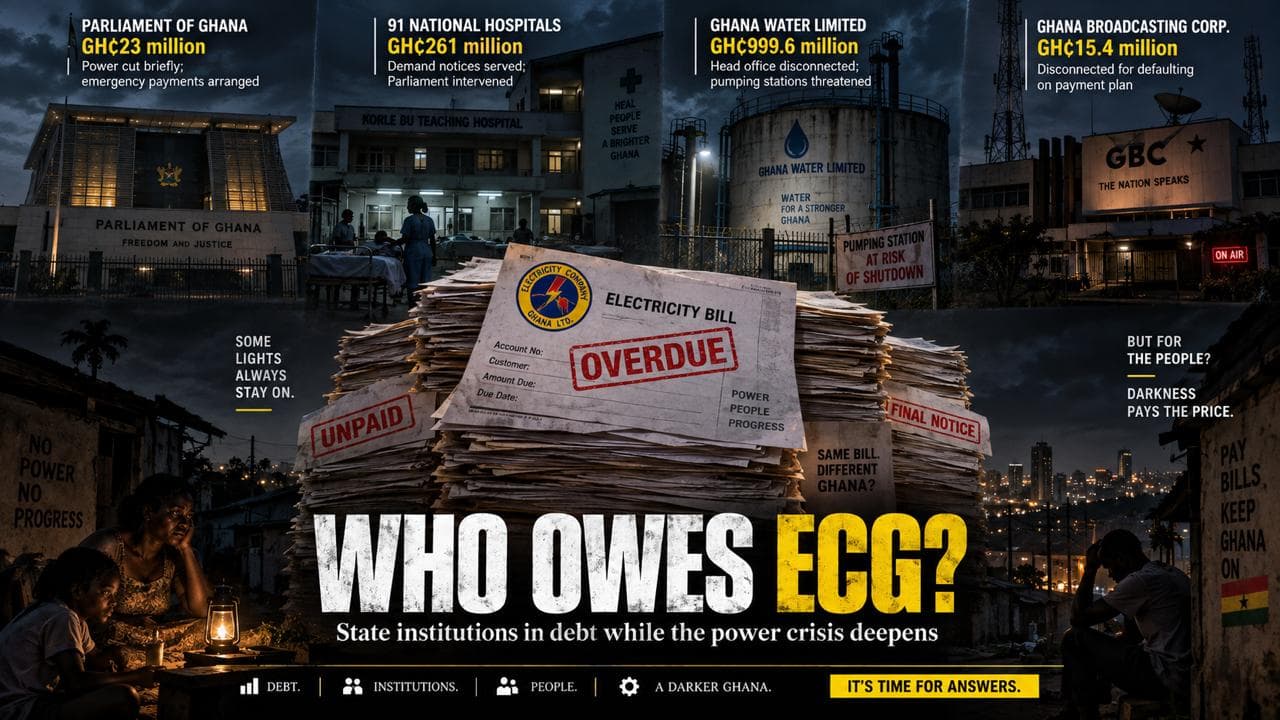
In June 2025, ECG dispatched its national task force to disconnect Ghana Water Limited's head office over an outstanding debt reported at GH¢999.6 million, threatening to cut power to pumping stations vital for nationwide water distribution, according to reporting by Yen and Citi Newsroom. The task force also served notices to disconnect 91 hospitals nationwide over debts totalling GH¢261 million — including Korle Bu, 37 Military Hospital, Ridge, Komfo Anokye and Ho Teaching Hospital — prompting parliamentary intervention, as reported by Pulse Ghana. Parliament itself was briefly disconnected over a debt of some GH¢23 million, forcing emergency payments arranged through the Ministry of Finance, according to Energy News Africa. The Ghana Broadcasting Corporation was cut off after defaulting on a payment plan for a GH¢15.4 million debt.
| Institution | Reported debt (GH¢) | ECG action |
|---|---|---|
| Ghana Water Limited | 999.6 million | Head office disconnected; pumping stations threatened |
| 91 national hospitals | 261 million | Demand notices served; Parliament intervened |
| Parliament of Ghana | 23 million | Power cut briefly; emergency payments arranged |
| Ghana Broadcasting Corp. | 15.4 million | Disconnected for defaulting on payment plan |
| Sources: Pulse Ghana, Yen, Energy News Africa and Citi Newsroom, cited under Sources. |
None of this is new. An IMF assessment from 2019 said government entities accounted for roughly 40 percent of outstanding utility-bill arrears at the time. As recently as March 2026, the Energy Minister was again publicly telling government institutions they must budget for electricity as they budget for vehicles and communications — and Citi Newsroom reported him criticising SOEs that find money for diesel generators during outages yet refuse to budget for grid power, announcing a new policy requiring all MDAs to make explicit budgetary allocations for power consumption.
The Government of Ghana owns ECG, depends on ECG to pay generators, and periodically rescues the sector with taxpayer money — while its own agencies fail to pay ECG on time. An MDA does not pay; ECG cannot fully pay upstream; arrears build; the Ministry of Finance eventually settles part of the debt with public resources. Not every cedi follows that exact chain, but the incentives are plainly perverse.
Tariffs, expensive generation and the hardware trap
The gravest analytical error would be to treat ECG as though its only job is collecting money from end users. It is squeezed between upstream costs it barely controls and downstream revenues it imperfectly controls.
During Ghana's earlier power crisis, the country signed numerous power-purchase agreements, some with rigid take-or-pay obligations. The Ministry of Finance said in 2020 that these legacy arrangements were costing Ghana more than US$500 million annually for electricity it did not use. World Bank documentation describes expensive thermal contracts and excess capacity as structural cost drivers.
Ghana has tried to unwind this. In 2025, the Ministry of Finance paid approximately US$1.47 billion to settle legacy debts across the energy sector, bringing total payables to IPPs and fuel suppliers down from US$2.1 billion at end-2024 to US$1.7 billion by March 2026, according to Modern Ghana's reporting on the debt clearance and Citi Newsroom's coverage of the Energy Minister. The government secured an additional US$250 million in savings through renegotiating IPP contracts and roughly US$500 million from switching from imported liquid fuels to natural gas, per the same reporting.
Those payments help explain the narrowing of the sector's overall shortfall. IMF assessments, as reported by MyJoyOnline and analysed by The Electricity Hub, put the energy-sector financial shortfall at US$1.6 billion (1.4 percent of GDP) in 2024, contracting to US$1.4 billion (1.2 percent of GDP) in 2025, with a projected shortfall of approximately US$1.1 billion for 2026. That remaining gap is deeply structural: the IMF estimates the power-sector component of the 2026 gap at about US$925 million, with another US$178 million tied to gas, and generation costs alone at roughly US$2.1 billion.
That is genuine progress. Yet the IMF still describes Ghana's electricity sector as vulnerable because the tariff, distribution and collection gaps have not disappeared.
Every cedi of unrecovered power cost eventually competes with health, roads and education for the same public purse — and that fiscal drag is what the IMF, the World Bank and successive governments keep circling back to.
Hardware is a real deficit. ECG's 2025 risk disclosures point to over-aged, obsolete equipment and faulty or missing meters. The ESRP therefore finances metering, smart prepaid meters, GIS customer indexing, integrated commercial systems, transformer upgrades, low-voltage rehabilitation and better energy accounting. Crucially, the "zero" smart meters flagged in the World Bank's mid-2026 review referred only to meters installed under that particular program — where progress had stalled completely — not to all meters ECG has ever deployed.
That stall is itself revealing. In June 2026 the World Bank downgraded the ESRP from "Moderately Satisfactory" to "Unsatisfactory," pinning the blame squarely on the Ministry of Finance, according to MyJoyOnline and Africa Sustainability Matters. In enforcing macro-fiscal discipline, the Ministry withheld the commitment authorisations needed for capital projects — paralysing the very smart-metering, energy-accounting and IPP-invoicing rollouts designed to stop ECG's commercial haemorrhaging. The state cannot starve a utility of the capital needed to stop theft and then expect it to become profitable.
Raising tariffs while leaving commercial losses untouched is like raising water prices while a quarter of the water leaks or is stolen before it reaches the meter. Some extra revenue is recovered, but honest customers end up subsidising everyone else's losses — a point the Energy Minister himself made in 2026.
Why hardware is really a governance story
Look closer and even the physical problems dissolve into governance problems.
Old transformers are hardware. Allowing them to stay overloaded for years is management. A missing smart meter is hardware. Failing to keep an accurate database of every customer on every transformer is an energy-accounting failure. A bypassed meter is theft. Failing to detect it for years is an enforcement failure. Government agencies not paying are customer arrears. Continuing to supply repeat defaulters because disconnection is politically awkward is governance. A below-cost tariff is a regulatory problem. Signing expensive dollar-linked take-or-pay contracts and then resisting the tariff needed to pay for them is a policy and governance problem.
Governance is the common denominator connecting nearly every ECG failure.
The way out: private participation, night tariffs and the vicious cycle
Assemble the leaks and a self-reinforcing loop appears: poor collections and high losses mean ECG cannot fully pay suppliers; supplier arrears grow; government steps in; taxpayers absorb liabilities; tariff increases are demanded; paying customers grow frustrated; theft and political resistance to enforcement rise; investment is delayed; losses stay high. The individual arrows shift year to year, but the loop is consistent with what ECG, the IMF and the World Bank all document.
The government's headline answer is structural. Driven jointly with the IMF, it aims to establish Private Sector Participation (PSP) in the distribution operations of ECG and NEDCo by early 2027, using a "Multiple Lease Model" that keeps assets in state hands while leasing regional concession zones to performance-based private operators, according to the Finance Ministry as reported by GhanaWeb and the Ghanaian Times. Under Draft A's reading of the model, the network would be segmented into regional zones pairing profitable urban centres with tougher rural demographics, with concessionaires remunerated through fixed service payments plus rewards for efficiency and penalties for missed loss-reduction targets. Consumer retail tariffs would remain uniform nationwide under PURC. A steering committee co-chaired by the Energy and Finance ministers was inaugurated in May 2025, per the Ministry of Energy and the Ghanaian Times. Organised labour — the Trades Union Congress and the Public Utility Workers Union — has vowed to resist, viewing the model as a trojan horse for job cuts and divestiture, but the IMF has made PSP a structural benchmark.
This is where the industrial cases matter most. Bringing heavy, high-value accounts like Kasapreko and Tema Oil Refinery into a fully-metered, disciplined billing relationship is exactly the operational competence performance-based concessionaires are meant to supply — and exactly what the stalled smart-metering rollout has so far denied ECG.
Pricing reform is the other lever. PURC now runs quarterly tariff reviews in both directions: it cut electricity tariffs in April 2026 on a strong cedi and favourable hydro mix, then raised them from July 2026 as the cedi slipped, according to Sweet FM and MyJoyOnline. In parallel, PURC is developing a Time-of-Use tariff to support the government's "24-Hour Economy," offering discounted "super off-peak" power to industries running night shifts, as reported by Norvan Reports. But that regime depends on the very smart meters the funding bottleneck has stalled — fiscal control actively hindering industrial policy.
The IMF's latest conclusion is the most important line in this whole debate. After years of reform and large government payments, it still says durable recovery requires tariff discipline, payment enforcement, arrears clearance, lower distribution losses, stronger governance, transparent procurement and greater private participation in distribution.
The evidence supports a clear hierarchy of causes. At the surface sit unpaid bills, theft, meter tampering, faulty meters, old transformers, public-sector arrears and lagging tariffs. One level down, ECG carries exceptionally high losses and incomplete collection while buying power whose cost is inflated by contracts, fuel and foreign exchange. At the root, Ghana has repeatedly failed to impose strong commercial governance over the whole value chain — accurate energy accounting, universal tamper-resistant metering, customer indexing, disciplined billing, politically neutral enforcement, transparent procurement, cost-conscious contracting, timely tariff adjustment and transparent transfer of cash upstream.
So the most defensible answer to "What is really wrong with ECG?" is this: not that electricity is too cheap, nor simply that Ghanaians refuse to pay, but that the institution and the wider power-sector architecture allow too much of every cedi of electricity purchased to disappear before that cedi becomes collectible, collected, reconciled and transferred upstream.
Everything else — customer debt, meter fraud, government arrears, obsolete transformers, tariff fights, IPP debt and repeated bailouts — is a symptom of that deeper failure. No single tariff increase, collection campaign, smart-meter rollout or bailout can fix it. The system needs to make every kilowatt-hour traceable from purchase to cash.
Sources: external deep research, Anansi News newsroom.
Cite us / embed this
Reusing a chart or stat? Please credit Anansi News and link back to this page.
Sources: external deep research, Anansi News newsroom.
Sources
- 1.imf.org. Gha
- 2.facebook.com. Imfs Assessment Of Ghanas Energy Sectorthe Strategic Stakes And The Gap Between
- 3.https://vertexaisearch.cloud.google.com/grounding-api-redirect/AUZIYQGFB6yMNKviyU9w6Hr47k0_BMAVMGoLMuCp6qDdFu5uJwuYK9XyrKdEE45-L0zJQU6V5n-QIY2ScH2QK-KE4UanKpVgQI-ZLSfcCeLt5duIdjUpNJnNgGgdLThQbDDFwc4M20HVBPCrWTGltA1W8DP9jzLy-cLqfU_JUej319yRx9S-OH-AADmo6CMzxIF9FyXrR2ixq7tYIJW1ssHwLzM_vehkh-uzNqGsisKOqFiYcLibASifUZw6T0mzWbK77qB1ky3kvY9hxFd0OXK_pChf5Bea8V-LCj9tUiVz9Q==
- 4.elibrary.imf.org. Article A001 En.Xml
- 5.elibrary.imf.org. Article A001 En.Xml
- 6.elibrary.imf.org. Article A001 En.Xml
- 7.elibrary.imf.org. Article A001 En.Xml
- 8.myjoyonline.com. Imf Cautions Ghana Over Energy Sector Despite Progress Made In Reducing Energy Debt
- 9.modernghana.com. Imf Urges Ghana To Sustain Quarterly Electricity
- 10.ghanacitizenship.com. Imf Urges Ghana To Keep Quarterly Electricity Tariff Reviews What It Means For Your Power Bill
- 11.sikanomist.com. Home
- 12.citinewsroom.com. Energy Sector Reforms Clear 1 4Bn Legacy Debt Save 750M Jinapor
- 13.facebook.com. %Ef%B8%8F World Bank Delivers A Damning Verdict On Mahamas Energy Sector Managementthe M
- 14.modernghana.com. Govt Clears 147 Billion Energy Legacy Debts
- 15.brettonwoodsproject.org. Ghana Pays Off Billions In Debt Linked To World Bank Backed Power Sector Reforms
- 16.gna.org.gh. Ecg Slashes Annual Loss From Ghs8 3Bn To Ghs2 5Bn Amid Revenue Surge
- 17.myjoyonline.com. World Bank Downgrades Ghanas Energy Recovery Programme To Unsatisfactory Cites Finance Ministry Fiscal Controls And Election Related Delays
- 18.egpghana.org. World Bank Flags Setbacks In Ghanas Energy Sector Reform Programme
- 19.modernghana.com. Ecg Reduces Annual Loss By 695 From Ghs8Billion
- 20.graphic.com.gh. Ecg Cuts Losses To Ghc2 5Bn As Power Costs Weigh On Finances
- 21.ignewss.com. Cedi Appreciation Cuts Ecgs Losses By Gh%C2%A212Bn In 2025
- 22.ghanaweb.com. Ecg Records Gh 2 5 Billion Loss Due To High Power Costs 2046267
- 23.trade.gov. Ghana Power Generation Outlook 2025
- 24.globallegalinsights.com. Ghana
- 25.documents1.worldbank.org. P173258 03A51B14 5F89 4758 Afb4 Ee6890C2E2Ee.Pdf
- 26.africasustainabilitymatters.com. Ghanas Electricity Reform Programme Downgraded By World Bank As Financial Losses And Implementation Delays Deepen Sector Crisis
- 27.https://vertexaisearch.cloud.google.com/grounding-api-redirect/AUZIYQHnL9yBLIcdFKpEU4mlBrR5OlcjMRBF4zgNO2rXNLtO4-DJvYiJ9p_xayCp885ERPXtUIyAbutB61mcL0huhHVfoBhf1J9BgA8Da4zhYQAHS_LDlMywDhhl_U-dfOfYoUvswQq-R7vd8MXRiECc41l9-984YE-vbluy9Dya3oLnce48mxdDIwSXTaAKVeqYwgmr7U6M16-L-vOOo-jUOBvNRA9Xu275SRoDchVw7id2gn7UN50WhJTNj9vLlqOQ-li7l9ghl5h88nuQY8DnUp1rJqbDRpEiP_1YlFuo64Q=
- 28.gbcghanaonline.com. World Bank Ghana Energy
- 29.ghanafact.com. Analysis Deconstructing The Finance Ministers False Claim That Ecg Revenue Has Risen Almost 90
- 30.facebook.com. Management Of The Ghana Gas Company Acquired A Building In 2025 At A Cost That W
- 31.facebook.com. Aksa Energy Deal The Attorney General Should Come And Address The People Of Ghan
- 32.facebook.com. Ecgs Revenue Collection Improves Find Out Why
- 33.facebook.com. Ghana Is Working To Begin Exporting Electricity To Nigeria As It Seeks To Become
- 34.facebook.com. The Electricity Company Of Ghana Ecg Has Launched A Massive Disconnection Exerci
- 35.https://vertexaisearch.cloud.google.com/grounding-api-redirect/AUZIYQHyLkusNXMh-GWTCoyEtUtgj8Tpc_ASAY2lkJa0MJmO-VNoH7vspOwpyo8agCvwNkQmHa-7KwvRDMigbHtI7QN28IMkLxWUlB5Zupj87aB6flUGwioEJGiM7ptQE-r7DEJtEQ4DR7P1vrsFncy_XwC8E2WAEErQIaHk2To3U2W9vZgBW6TduibJ_inpbua-iJdW2Zs_vT0vKHkGKwF-TFnF4-_2Sr4acFQjd9P7iw==
- 36.citinewsroom.com. Jinapor Tells Non Exempt Soes To Pay Electricity Bills
- 37.citinewsroom.com. Ecg Collection Losses Hit Gh%C2%A22Bn In Nine Months Of 2023
- 38.facebook.com. Ecg Pulls The Plug On Ghana Water Limitedghana Water Has Been Disconnected From
- 39.facebook.com. Posts
- 40.pulse.com.gh. Heres Why Ecg Wants To Disconnect 91 Hospitals Over Ghcent261M Debt 2024072416281613685
- 41.facebook.com. Gwcl Cuts Water Supply To Guinness Ghana Limited Over Ghs67M Debt Citi Newsroom
- 42.facebook.com. %F0%9D%90%84%F0%9D%90%9A%F0%9D%90%Ac%F0%9D%90%Ad %F0%9D%90%81%F0%9D%90%9A%F0%9D%90%A7%F0%9D%90%A4 %F0%9D%90%83%F0%9D%90%A2%F0%9D%90%Ac%F0%9D%90%Ab%F0%9D%90%Ae%F0%9D%90%A9%F0%9D%90%Ad%F0%9D%90%A2%F0%9D%90%A8%F0%9D%90%A7 Customers From Garden Of Eden To Coverden Please Note The D
- 43.yen.com.gh. 285487 Ecg Disconnects Ghana Water Ghc1 Billion Debt Storms Gbc
- 44.https://vertexaisearch.cloud.google.com/grounding-api-redirect/AUZIYQGHNGM0-d_CEa41zhL8HLo9mnhqKVFY6ISZrbDA09kzMrXLPFXjrVVnOYnyLvLlU1Q9yBaX8ufX2hDE_2lBy2KCtr_OHXGiPa3HYi4nK97I93OFP4SUvYtRN0IJ65BF814qsRXcXuTK7iqfx-isscBxKXS1R0mAEWer90sbkMpW9q0gsG_UbuWUJ6H2grKVKLQ=
- 45.energynewsafrica.com. Ghana Fear Of Disconnection Forces Parliament House To Settle Part Of Debt Owed Ecg
- 46.facebook.com. A Nearly Broken Ecg Pole Is Hanging Dangerously At Gbawe Bulemin Policeman Area
- 47.youtube.com. Watch
- 48.facebook.com. Bismark Brown Fires Why Is Ghana Gas Procurement Head Still In Office After 60Ep
- 49.cbodghana.com. Ecg Officials Aided Consumers To Do Illegal Connections Meter Tampering Acep Reveals
- 50.researchportal.northumbria.ac.uk. 1 S2.0 S030142152600354X Main.Pdf
- 51.facebook.com. Ecg Power Theft Two Cold Store Operators Surcharged Ghs 90000 For Meter Tamperin
- 52.facebook.com. Ashanti Ecg Hails Regsec For Helping To End Theft Of Electricity Conductors Elec
- 53.facebook.com. The Tarkwa Nsuaem District Manager Of The Electricity Company Of Ghana Ecg Engin
- 54.facebook.com. The Ghana Standards Authority Gsa Has Announced Mandatory Testing Verification A
- 55.ecg.com.gh. Ecg Calls For Stronger Measures To Deal With Illegal Meters
- 56.ghanaiantimes.com.gh. Ecg Calls For Stronger Measures To Deal With Illegal Meters
- 57.ecg.com.gh. News Events
- 58.theelectricityhub.com. Ghanas Energy Sector Shortfall To Reach 2 2 Billion Imf
- 59.myjoyonline.com. Electricity Tariffs Increases By 3 49 Water By 0 85 Effective July 1
- 60.sweetfmonline.com. Purc Tariff Reduction Ghana April 2026
- 61.allafrica.com. Stories
- 62.youtube.com. Watch
- 63.facebook.com. 24 Hour Economy Policy The Institutional Structure Of The 24 Hour Economy Author
- 64.facebook.com. Ghanas 24 Hour Economy Plan Aims For 2 Million Jobspresident John Mahama Says Th
- 65.ghanaweb.com. Power Struggle Why Ghana S 24 Hour Economy Needs Affordable Electricity To Succeed 1976148
- 66.norvanreports.com. Purc Develops Night Time Electricity Tariff Regime To Support 24 Hour Economy
- 67.graphic.com.gh. Ghana News Boost For 24Hr Economy Purc To Introduce Night Power Tariffs For Businesses
- 68.ghanaweb.com. Private Sector Participation In Ecg To Begin By Early 2027 Finance Ministry 2034932
- 69.citinewsroom.com. Ecg Private Sector Participation To Begin By Early 2027 Finance Ministry Adviser
- 70.ghanaiantimes.com.gh. Energy Ministry Unveils Framework For Private Participation In Electricity Distribution
- 71.graphic.com.gh. Ecg Private Sector Participation To Start By Early 2027 Finance Ministry Adviser
- 72.energymin.gov.gh. Government Inaugurates Steering Committee Boost Private Participation Power Distribution
- 73.graphic.com.gh. Ghana News Energy Sector Govt Rolls Out Guiding Framework For Private Sector Participation
- 74.ghanaiantimes.com.gh. Govt Inaugurates Steering Committee To Boost Private Participation In Power Distribution
- 75.facebook.com. Ato Saidat The Future Of Energy Conference I Explained That Ghana Is Building A
- 76.thevaultznews.com. Government Ecgs
- 77.thebftonline.com. Ghanas Electric Power Outages And Blackouts Ending The Persistent Electric Load Shedding Dum Sor Problem From The Perspective Of A Seasoned Electric Power Industry Practit
- 78.authorea.com. Authorea.15006462
- 79.energycom.gov.gh. Codes Sub Codes
- 80.researchgate.net. 320596657 The Electricity Situation In Ghana Challenges And Opportunities
- 81.indexbox.io. Africa Power Factor Correction Systems Market Analysis Forecast Size Trends And Insights
- 82.scribd.com. Nigeria Energy Sector Review H2 2025 2026 Strategic Outlook Aluko Oyebode
- 83.facebook.com. Purc Calls For Major Reinvestment In Ghana Gas To Secure Power Sector Stability
- 84.facebook.com. Ecgs Biggest Problem Now Is Metering No Matter How Much Tariff Adjustment Is Don
- 85.facebook.com. Acep Backs New Guidelines To Curb Methane Emissionsthe Africa Centre For Energy
- 86.Anansi News. Anansi News newsroom coverage
Related: John Mahama News